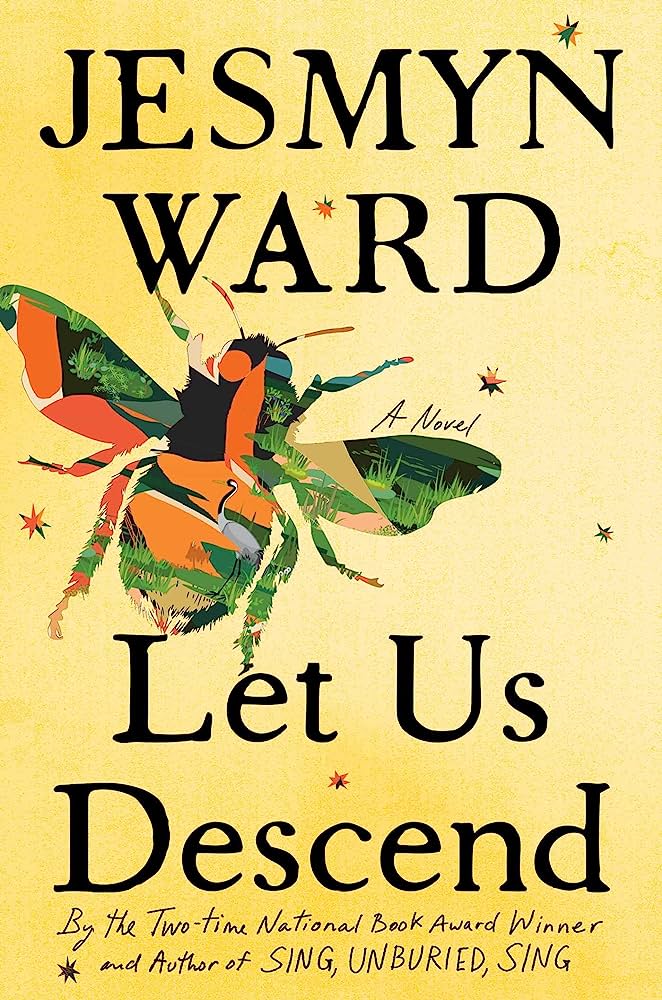
Let Us Descend is a sensory experience like no other. Every searing page beckons the reader to descend further into Jesmyn Ward’s nightmare world of grief, enslavement, and spiritual mysteries.
Taking literary inspiration from Dante’s Inferno, Ward invites us to follow along on an odyssey through hell. That hell, of course, being slavery. Our guide is Annis, born enslaved in North Carolina but the granddaughter of a woman warrior from Africa. Annis is already well acquainted with loss and pain by the time we meet her, but things quickly go from bad to worse. Her mother, who has taught Annis to fight even though these skills appear useless to them in their present circumstances, is sent away with a slave trader after protecting her daughter from the advances of the plantation owner (who is also Annis’ father). After allowing herself to be consumed by grief and a sexual relationship with another enslaved girl, Annis herself is picked up by the slave trader and sent through dangerous, unknown wilds to New Orleans before ending up on a sugar plantation.
Jesmyn Ward won National Book Awards for her two most recent novels, Salvage the Bones and Sing, Unburied, Sing (one imagines that the odds are strong that she is positioned, with Let Us Descend, for a hat trick). In my mind, she also would have been the correct choice for the Pulitzer Prize for Fiction with Sing, Unburied, Sing, but alas, that did not happen (one hopes that the Pulitzer Board is primed to set things right when they announce this year’s winner in 2024). Given that, you can see why Let Us Descend is one of the most hotly anticipated book releases of 2023.
The hype machine can be unforgiving. If you set your expectations very high, it can be nearly impossible for anyone to reach them. So allow me to be a little measured when I say that Let Us Descend is one of those rare gems capable of withstanding the pressure of expectation.
In that vein, allow me to say that while Jesmyn Ward is remarkably skilled as a writer, she has a tendency to default to sentences that feel like lists of descriptors. It’s fine, but it happens to be a pet peeve of mine, and it happens enough that it feels like a writing tic she can’t quite control–even as you know that Ward’s writing has the control and precision of a poet.
I will also say that ultimately, Let Us Descend doesn’t feel groundbreaking. It’s not reinventing the wheel, it’s not coming up with an inventive or creative way of approaching a story about enslavement, and in those ways, it feels a touch familiar. In some ways, if you have read Beloved, this won’t feel new. Especially since Beloved deals with ghosts and Let Us Descend deals with spirits who are tied to nature.
However, what Jesmyn Ward does bring to the table is a rather unprecedented sensory experience. She makes you feel what Annis feels, gets you to smell what she smells and taste what she tastes. When Annis touches something, you can imagine exactly what it feels like. When she hurts, the pages blister with her pain. When she gets hungry, your stomach contracts.
This, combined with the overwhelming sense of grief that pervades the novel (understandably, given that Ward lost her husband in January of 2020) can make for an unpleasant reading experience–in much the same way that Toni Morrison’s Beloved feels unpleasant to read. However, in both cases the prickliness is deliberate. After all, why should a novel about enslavement make you feel good? In that sense, Let Us Descend feels like a, well, descendant of Morrison’s landmark novel (which would be appropriate if Ward does win the Pulitzer next year, since she would be the first black woman to do so since Morrison won for Beloved in 1988).
But while Beloved is largely intellectual and punctuated with violence, Let Us Descend is a more visceral experience. It isn’t using metaphor or symbolism, and it isn’t forcing the reader to be an active participant in order to understand what it’s doing. It does have that stuff with the spirit world, and honestly, I’m not quite sure I understand everything happening there, but the power of Let Us Descend comes from Ward’s ability to put you on the ground with its characters. She situates you in the text so you experience everything.
Let Us Descend has much in common with another Pulitzer winner: Colson Whitehead’s The Underground Railroad. Like that book, Let Us Descend lures the reader through a nightmare journey to understand the human toll of enslavement (foregoing the elaborate framing device in which the Underground Railroad becomes an actual train).
This might sound like lofty company, but it’s entirely earned. Jesmyn Ward deserves a seat at the table with these celebrated books and authors.
But I don’t make these comparisons to imply that Jesmyn Ward is derivative–far from it, in fact. Her work is imbued with a sharp ferocity, a desperate desire to survive. It is also full of love, frequently maternal in nature (especially Salvage the Bones). That is where a lot of the power of Ward’s writing can be found.
If I say that Let Us Descend doesn’t tower over Salvage the Bones or Sing, Unburied, Sing, please don’t take it as an insult. It is not. It is merely a sign that Jesmyn Ward has set an incredibly high bar for quality–and the fact that she continues to meet it is quite impressive.
 Supposedly Fun