After the death of Cormac McCarthy, I saw many people reference a 2006 article from The New York Times in which they named Toni Morrison’s Beloved as the best book published in the previous 25 years. If you’re wondering why that article is relevant for Cormac McCarthy, his 1985 novel Blood Meridian was one of the four runners-up for the title.
It’s an interesting article to look at, but it’s been seventeen years since it was published. All of the top five books (including the other three runners-up: Don DeLillo’s Underworld, John Updike’s inexplicably lumped-together Rabbit Angstrom novels, and Philip Roth’s American Pastoral) are outside of the last 25 years. So I started to wonder: what would this list look like if it were made today?
I went back and selected my top 25 fiction books published from 1998 through today. I had to make some tough cuts along the way. At the bottom of this page, I’ll include a list of books that I haven’t read yet that might have made it onto this list–as well as some books and authors I didn’t like enough, but who might appear on the lists of anyone else who decides to do this list.
But right now, let’s just get into the list.
First, a Note
I’m a white dude living in the United States. I started reading more literature in translation recently, but this list reflects my very Western view of what constitutes great literature. The reality is that every book on this list was published in English, but I am pleased to see that it reflects. a good range of diverse authors and stories within the English language. It’s just not a global list, and I acknowledge that this is a failing of mine–not of any global authors, who frankly deserve better respect. I can only present my list as it stands and pledge to do better in the future if I ever want to do another list like this again.
I also tend not to read a lot of science fiction, fantasy, romance, or mystery novels. This list reflects my slant toward literary fiction (even though I hate the term ‘literary fiction,’ it remains the name for the category of literature I read most often, so here we are).
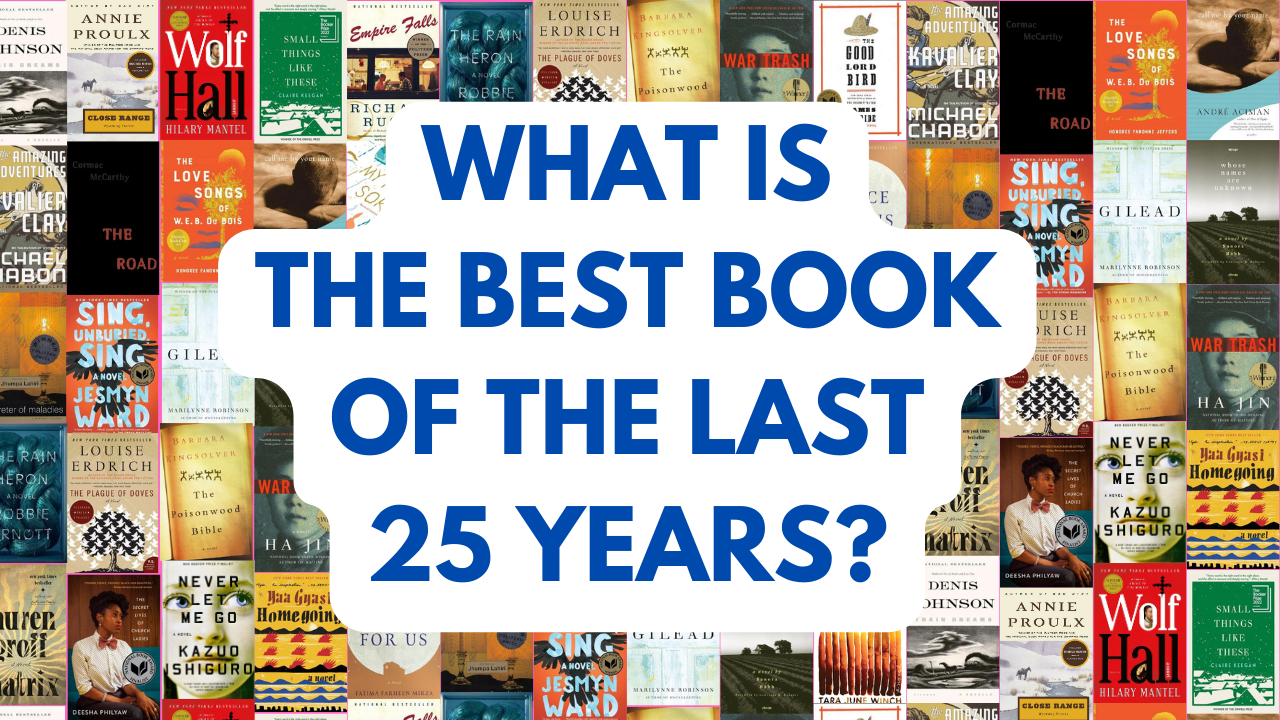
The 25 Best Fiction Books of the Last 25 Years 📚
This list is in alphabetical order by author. If you just want the top five, skip to that section.
Call Me By Your Name, Andre Aciman (2007)
Incidentally, this was one of the first books that my husband, Joel, recommended to me. The fact that he hit it out of the park scored him a lot of points.
Call Me By Your Name is a very queer novel about lust and the way first love can become like an obsession. Every page burns with desire, perfectly using the setting (a vacation home in Italy in the 1980s) to exaggerate the sense of passion in a temporary environment. To me, this is such a perfect book that I refused to read the sorta-sequel Find Me–especially after that book got wildly mixed reviews.
The Rain Heron, Robbie Arnott (2020)
This Australian novel goes to some wild and unexpected places, with some details I won’t go into here that really exacerbated my fear of the ocean and everything in it. I don’t want to go into it because I think knowing anything beyond the basic premise of this book could lessen your experience of it–everything in the description on the back of the book happens within the first fifty pages, allowing the story to unfold in very unexpected directions. It also has two fantastic female protagonists. I’ll say no more.
Whose Names Are Unknown, Sanora Babb (2004)
Call this a cheat if you must, but I don’t care. Originally written in the late 1930s, the publishing deal to release Whose Names Are Unknown was canceled when The Grapes of Wrath became a massive success, making Babb’s publisher too afraid of looking derivative (I go into Babb’s unusual ties to Steinbeck’s novel in my deep dive on that book). Whose Names Are Unknown, which I actually like better than The Grapes of Wrath, was finally published in 2004–which puts it squarely in the time period for this list. So there.
An extremely humane and empathetic book, Whose Names Are Unknown is the story of a family struggling to survive the Dust Bowl, ultimately moving to California for salvation, only to find continued struggle.
The Amazing Adventures of Kavalier & Clay, Michael Chabon (2000)
An epic, sprawling Pulitzer Prize winner (the first of five Pulitzer books on this list), this novel follows two cousins, Joe Kavalier and Sammy Clay, as they build towering success during the golden age of comic books. But their stories are tied up in larger, thornier issues like immigration, sexuality, and (most significantly) the United States during the build-up to entering World War II. It’s a fascinating book, not just in the way it portrays how entertainment can be used to influence politics (and vice versa) but in the human story at the center of it all.
The Plague of Doves, Louise Erdrich (2008)
In many ways, you could say that Louise Erdrich’s best novel is actually her first, Love Medicine, which was published outside of the time frame we’re looking at here. I think The Plague of Doves, which was a Pulitzer Prize finalist, is the high point of all the narrative threads Erdrich set in motion with her debut. Like many of her novels, this one has a terrible crime at its core and features a wide array of indelible characters (some with ties to Erdrich’s other novels). It also heavily deals with injustice and community. And it can be surprisingly funny.
Matrix, Lauren Groff (2021)
The difficulty with a lot of recent publications is that you don’t really know how well they’re going to sit with you over time. I struggled with whether or not I think Matrix needs more time to prove itself, but ultimately: I love this novel about a girlboss lesbian nun in the 12th century. I love how it unfolds, I love the voice of the protagonist, and I love how it talks about the role of women in history (and how the importance of women is often erased or underestimated). It’s the real deal.
Homegoing, Yaa Gyasi (2016)
Homegoing had the spectacular misfortune of having all its thunder stolen by another novel that was published the same year: Colson Whitehead’s The Underground Railroad. Whitehead ate up book prizes (including the Pulitzer) and critical citations, and Homegoing seemed poised to be forgotten. Thankfully, I’ve recently heard some people praise it, and I really hope that more people discover it.
The story begins with two sisters in the same place: 18th-century Ghana. One sister is sold into slavery and the other stays in Ghana. Every chapter of the book leaps ahead one generation, alternating between the descendants of each sister. In doing so, Gyasi manages to write a novel about not just the lasting implications of slavery in the United States, but the world at large. I think it’s brilliant.
Never Let Me Go, Kazuo Ishiguro (2005)
This is something of a cilantro book, so your mileage may vary. I love it. The existence of a film adaptation and general discourse around the book have largely spoiled what it’s actually about, so I encourage you to go in as blind as you can and let the direction of the novel surprise and haunt you. All you need to know is that it follows three students at a mysterious boarding school. The narrative is a bit slow and meandering, but to me it mimics the way memory ebbs and flows–and how stories are frequently told with digressions and asides. And when it gets to the end? Heartbreak.
The Love Songs of W.E.B. Du Bois, Honorée Fannone Jeffers (2021)
Despite the proximity of this book’s publication date, I knew it was going to appear on this list the moment I decided to create it. What Jeffers achieved with this novel, which she refers to as a ‘kitchen table epic,’ is frankly astonishing. It’s a novel about the history of a family and the history of a place, and how those two things are tied together. It’s also the story of a young black woman growing up and coming into her own power and agency. It’s one of the best-written books I’ve ever read.
War Trash, Ha Jin (2004)
This is probably one of the lesser-known books I have on this list, and I really hope that more people discover it. My elevator pitch is that it’s like The Things They Carried but set among Chinese soldiers held in an American prisoner of war camp during the Korean War. It’s a gritty war-is-hell novel that also heavily deals with human nature. It’s compelling and difficult and would be well worth your time.
Train Dreams, Denis Johnson (2011)
Originally published in a 2002 issue of The Paris Review, Train Dreams was published as a novella in 2011 and (probably) nearly won the Pulitzer Prize (it was a finalist in a year where no winner was selected). Johnson is mostly known for his electrifying story collection Jesus’ Son or his hefty novel Tree of Smoke, but it’s this one for me. It packs a mean punch in a small package, deftly telling a story about grief, the American West, and the transformative power of time.
Small Things Like These, Claire Keegan (2021)
Speaking of big punches in a small package, here’s another 2021 publication for you (turns out that was a good year for books). This one is an Irish novella about a man faced with a difficult decision in 1985: he can either do the right thing against an insurmountable enemy, or he can turn a blind eye and let injustice continue. It’s a spectacular short novel.
The Poisonwood Bible, Barbara Kingsolver (1998)
Thank goodness this book barely made it into the time period for this video, because I love talking about this book. The whole last year has been great for me because I’ve had so many opportunities to tell people about how much I love The Poisonwood Bible as Demon Copperhead has been on its awards run. This book begins in 1959 and follows a white American family as they arrive in what was then The Belgian Congo to do missionary work. They quickly learn that they are wildly out of their element. It’s a beautiful novel and I love it.
For the record, Demon Copperhead was on my longlist for this post, but I decided I need to give it a little more time to sit before I put it in such lofty company.
Interpreter of Maladies, Jhumpa Lahiri (1999)
This is one of my all-time favorite short story collections. If you’ve ever read anything by Jhumpa Lahiri, you know that her writing is gorgeous. That is true even in her debut. These stories are about immigration and the divides that form in its wake–not just between two geographic areas but also between cultures and people. It is eloquent, quiet, and very powerful. It’s a Pulitzer Prize winner for Fiction, and a good one.
Wolf Hall, Hilary Mantel (2009)
I admit that I almost included the sequel to this book, Bring Up the Bodies, instead. That one is my favorite book in Mantel’s landmark trilogy about Thomas Cromwell. It’s shorter, it’s sharper, it’s less frustrating to read. However, as I thought about it, I realized that Bring Up the Bodies is only able to be short and sharp because it benefits from the foundation Mantel lays with Wolf Hall. You can certainly appreciate Bring Up the Bodies if you haven’t read Wolf Hall, but the payoff is better if you read them in order. And the truth is, as much as I complain that Wolf Hall is a dense read (it is), I’ve been thinking about it ever since I read it. It stays with you.
The Good Lord Bird, James McBride (2013)
This is a wild read that is funny and insightful. It follows a young enslaved boy pretending to be a girl in order to survive the bloody conflicts that have broken out in the Kansas territory in 1856. Our protagonist is forced to follow along with the legendary (and real) abolitionist John Brown, ultimately leading to the raid on Harper’s Ferry in 1859–a catalyst for the Civil War. So this is a novel about history and slavery and racism, but it’s also very much about identity–especially since our protagonist has assumed another identity in order to survive. In certain ways, it’s also about how racism and enslavement alienate you from yourself. It’s very powerful.
The Road, Cormac McCarthy (2006)
The original list from The New York Times was published a few months before Cormac McCarthy released The Road, which ultimately won him a Pulitzer Prize for Fiction. It was one of the best-reviewed books of that decade, so it’s likely that if the Times list had been published a year or two later, this book would have been more competitive than Blood Meridian. But over the last ten years, the pendulum has swung back to Blood Meridian. It’s just an interesting evolution–and a great case-in-point for how enthusiasm can change over time. The Road is a tremendous and violent book either way, following a father and son as they try to survive the tatters of civilization.
A Place For Us, Fatima Farheen Mirza (2018)
This is an unabashedly personal choice for me. This is a novel about a fractured family that hit me in all the feels. I felt emotionally devastated when it was over (in the best possible way), and then I was supposed to just go on with my life as if everything was fine. It was not fine. I was a mess. The inciting incident is that an estranged brother and son is invited to his sister’s wedding, and he agrees to attend. What unfolds is a stunning story about family, immigration, religion, parenthood, and the ways small fractures left unattended can ultimately cause huge, impassible divides. I love this book.
The Secret Lives of Church Ladies, Deesha Philyaw (2020)
You knew my beloved was going to be in here somewhere, right? 2020 was a cursed year for the world thanks to the pandemic, but it gave us two books on this list. This one is a landmark short story collection for me. It follows the inner lives of black women facing the expectations that society has foisted upon them, and confronting the ways those expectations can fly in the face of their own wants and desires. It’s very much about religion, as you can tell from the title, but its message goes much further than just that (I think).
Close Range: Wyoming Stories, Annie Proulx (1999)
This short story collection is probably most famous for giving us Brokeback Mountain, but don’t sleep on the rest of the stories. Annie Proulx is a phenomenal writer, and in my opinion no book shows her skill off better than this one (yes, not even The Shipping News, which won her a Pulitzer). There’s a passage from the first story, The Half-Skinned Steer, that implanted itself in my brain. It’s that good. Proulx’s writing is blunt, sparse, and powerful.
Gilead, Marilynne Robinson (2004)
When Gilead won the Pulitzer Prize after it was published, I read it and thought it was fine. I also read Housekeeping, which was, at the time, the only other book Robinson had published (significantly, part of the lore of Gilead at the time was that it was Robinson’s first novel in 24 years). Being in my early twenties at the time, Housekeeping was much more my speed because it’s a coming-of-age novel. Over time, however, Gilead proved to have burrowed into my psyche. It still lives in my mind and my heart, and as I worked through my thirties and experienced fatherhood in untraditional ways, I kept thinking about Gilead. When I started my Pulitzer Prize Project, this was one of the books I was most excited to reread. I had lost or gotten rid of my copy, so I went to a bookstore to pick up a replacement. I read the first page of the book and found myself moved to tears. It was entirely unexpected and, I think, just goes to show that sometimes your opinion of a book changes over time. Your understanding of a story evolves as you age and gather life experience. And that’s a good, fascinating thing.
Empire Falls, Richard Russo (2001)
This is probably one of the quietest, most low-key books on this list. I read it after it won the Pulitzer Prize for Fiction and liked it, but I don’t think I expected it to live with me twenty years later. Sometimes you just can’t predict the books that will stay with you. First of all, Richard Russo is a first-rate storyteller who excels at blue-collar stories about America moving away from the Boomer era. I’m due for a reread at this point, but one of the things I have enjoyed about Russo’s writing is that he approaches the changing face of America with nostalgia but without fixation. Perhaps the story of Miles Roby, who has been running the Empire Grill for twenty years and is finding ways to reinvigorate his business, is the best example of Russo’s nostalgia at work: you can miss times gone by even as you keep working for the future.
All My Puny Sorrows, Miriam Toews (2014)
It is exceedingly hard for a book to make me cry and for a book to make me laugh out loud, and All My Puny Sorrows did both. Repeatedly. This is a story inspired by Toews’ real life and relationship with her sister, which makes it even more heartbreaking. It follows two sisters: one a world-famous pianist who is determined to end her life and the other unsure if the best way to help her sister is to convince her to live or to let her go. It sounds awful (and it is, to a degree), but it’s also deeply funny and moving. I am a lifelong devotee of Miriam Toews for this novel alone.
Sing, Unburied, Sing, Jesmyn Ward (2017)
My favorite Jesmyn Ward novel remains Salvage the Bones because its raw power hasn’t left me since I finished it, but I have to admit that the overall best book we’ve gotten from Ward (so far) is Sing, Unburied, Sing–a novel that calls back to the best work of William Faulkner. It is also a novel about the messy heart and soul of America, revealed through the story of a family traveling through Mississippi and reckoning with a deep history of violence that still holds power today. It’s powerful, visceral stuff.
The Yield, Tara June Winch (2019)
This is one of only two books on this list that didn’t originate in North America or Europe, and interestingly both of those books came from Australia. The Yield is an Australian novel that feels every bit as relevant or urgent to an American reader because it deals with the ways indigenous people have been dispossessed, displaced, disenfranchised, and more. It’s also a celebration of language and ways of keeping your heritage alive. It’s also the story of a complicated family, and you know I always love that.
Near Misses 📖
I originally included Hilary Mantel’s Bring Up the Bodies, Jesmyn Ward’s Salvage the Bones, and Barbara Kingsolver’s Demon Copperhead–which would have given all three authors two slots on the list. I ultimately decided to drop Bring Up the Bodies in favor of Wolf Hall for the reasons noted above. I also decided to allow Demon Copperhead more time to sit with me before running the risk of overstating my love for that book. And Salvage the Bones was one of my final, painful cuts to make my arbitrary decision to only include 25 books to match 25 years.
The other three books that were painful final cuts were Douglas Stuart’s Shuggie Bain, Benjamin Alire Sáenz’s Aristotle and Dante Discover the Secrets of the Universe, and Maggie O’Farrell’s Hamnet. Perhaps I made a bit of an over-correction worrying about recency bias in creating this list, but as hard as it was to lose them, I do stand by the decision.
My Top Five 🥈
Creating a list of only 25 fiction books was difficult enough. Can you imagine how hard it was to narrow it down even further to only five? And then pick a single winner? Madness. But here are the books I selected to round out my top five fiction books of the last 25 years:
Note: titles are listed alphabetically by author.
The Plague of Doves, Louise Erdrich (2008)
I seriously debated between this one and The Yield–and then noticed that through sheer coincidence, I was pitting two books about the indigenous experience against each other. Ultimately, my heart belongs to Louise Erdrich.
Never Let Me Go, Kazuo Ishiguro (2005)
This book just haunts me. If you want to be punny about it, I’m never going to let it go.
The Poisonwood Bible, Barbara Kingsolver (1998)
Including this one in the top five was a no-brainer. It’s one of my all-time favorites.
Close Range: Wyoming Stories, Annie Proulx (1999)
Quite simply, this is one of the best short story collections ever written.
Gilead, Marilynne Robinson (2004)
Robinson’s writing in this book and its profound humanity have had the most unexpected hold on me of any book on this list.
The Best 🥇
I said that it was difficult picking a winner, and it was, but the truth is that I very quickly knew my top two contenders. For me, it came down to The Poisonwood Bible and Gilead. I knew they were my top two contenders from the moment I decided to make this list. The only question was which one would come out on top.
Both novels took turns in first place at varying points in the roughly three weeks I worked on this. Even today, as I am finalizing this list, I keep waffling back and forth.
I think the reason it’s so difficult is that I haven’t reread Gilead yet. And to be fair, I haven’t reread The Poisonwood Bible yet either. Without those rereads, I’m going off of my first impressions–and as noted, I think I was too young for Gilead the first time around. My appreciation for that book has grown enormously over time.
Without rereading them, I feel stuck between my personal choice (The Poisonwood Bible) and what I think is objectively the best book on the list–not to mention the one I think I might prefer if I were to read it now (Gilead). And although I might have a different answer if you ask me again tomorrow, I think for right now I have to side with the book that I think is objectively the best. The best fiction book of the last 25 years is Marilynne Robinson’s Gilead.
And for the record: my third-place finisher would have been Never Let Me Go, fourth place would have been Close Range, and fifth would have been The Plague of Doves.
On My TBR 📕
Here’s a list of books published over the last 25 years that I could not take into consideration because I have not read them (yet).
The White Tiger, Aravind Adiga
Oryx and Crake, Margaret Atwood
Days Without End, Sebastian Barry
The Idiot, Elif Batuman
The Sellout, Paul Beatty
Year of Wonders, Geraldine Brooks
Milkman, Anna Burns
True History of the Kelly Gang, Peter Carey
Outline, Rachel Cusk
In the Distance, Hernan Diaz
Ducks, Newburyport, Lucy Ellman
The Gathering, Anne Enright
The Trees, Percival Everett
Tinkers, Paul Harding
A Brief History of Seven Killings, Marlon James
The Orphan Master’s Son, Adam Johnson
The Known World, Edward P. Jones
Behold the Dreamers, Imbolo Mbue
Circe, Madeline Miller
Cloud Atlas, David Mitchell
Lanny, Max Porter
Normal People, Sally Rooney
The Blackwater Lightship, Colm Tóibín
Still Life, Sarah Winman
Tin Man, Sarah Winman
Not For Me 🚫
These are books or authors I have read but did not enjoy, which means they did not merit a place on the list for me.
Jonathan Franzen
Ottessa Moshfegh
Haruki Murakami (other than Wind-Up Bird Chronicle, which is ineligible for this list)
The Overstory, Richard Powers
Tenth of December, George Saunders
Ali Smith
The Goldfinch, Donna Tartt
A Little Life, Hanya Yanagihara
 Supposedly Fun
Just a tad of feedback which you asked for. I have read (& agree with) about half the books on your list. I wrote down a dozen that I plan to read because of your description. Because you asked, my favorite in the past 25 years is People of the Book by Geraldine Brooks. I just discovered you & enjoyed watching this very much! I’ll be back…thanks!
LikeLike