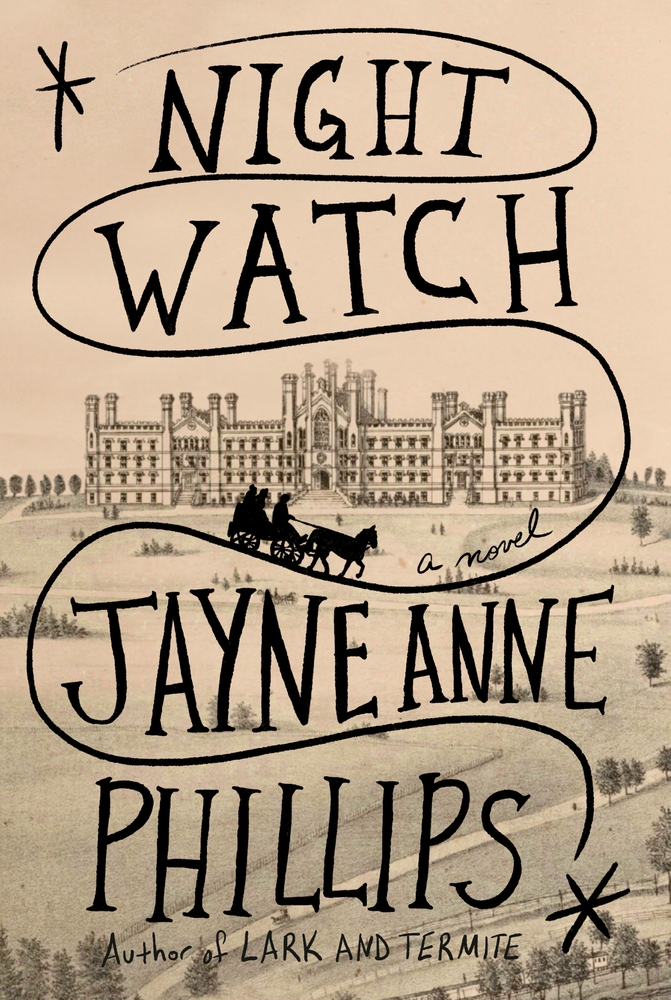
The Pulitzer Prize for Fiction had a big surprise when it announced the 2024 fiction prize. A ‘Pulitzer Surprise,’ if you will. In a year with no shortage of worthy competition and many big-name authors in the mix, the winner ended up being Jayne Anne Phillips for her mostly unnoticed historical fiction novel Night Watch.
Understandably, a lot of readers were a bit confused (and somewhat annoyed) that the heavy favorites had been overlooked. This is a problem with the Pulitzer, and I’ll get into that in a future post, but when you don’t get a longlist or shortlist in advance, people have to guess which way the wind might be blowing. When you’re wrong, it’s frustrating. It just is. Fair or not, there was instantly a lot of grumbling that the Pulitzer had gotten it spectacularly wrong.
In my reaction video, I was optimistic about the announcement. I had heard good things about Jayne Anne Phillips before (most specifically with her 2009 novel Lark & Termite), and Night Watch had been on my list of exciting novels publishing in the second half of 2023. So maybe this was the kick in the pants I needed to finally get around to reading her work. I even picked up three of her backlist titles at my local used bookstore, fully anticipating that this could end up being one of those cases where a win for a mostly-obscure author or novel ends up introducing me to something great.
But I read Night Watch now, and let’s just say that didn’t end up being the case. At all.
It’s always hard to evaluate where a book will ultimately sit in the pantheon of Pulitzer Prize winners when you’re so close to when it was published. It can be hard to tell if a winner will end up being a classic like To Kill a Mockingbird or The Grapes of Wrath, or if it will be completely forgotten in time–existing only as a title people reading all the Pulitzer Prize winners (like me) have to get through to complete their mission. In this Deep Dive, I’ll wrestle with whether or not Night Watch will end up being a great discovery like Tinkers proved to be, or if the Pulitzer jury and Board really did get it spectacularly wrong.
What Is Night Watch About?
Set in the chaotic aftermath of the Civil War, Night Watch is, thematically at least, about the lingering damages of war. It shows how the trauma of violence and upheaval have ripple effects that continue to harm bystanders and even subsequent generations of people long after “peace” has been declared.
In terms of plot, Night Watch follows several characters, mostly ConaLee (pronounced conna-lee, not like the name Connelly, although Phillips has a surprise in store there that made me roll my eyes). At least, she’s the only character who speaks to us in the first person. ConaLee is twelve years old but has been the primary caretaker for her young siblings and for her mother, Eliza, who hasn’t spoken in over a year. A man only known as Papa, whom ConaLee had believed to be her father, gives away the young children and deposits ConaLee and Eliza at the Trans-Allegheny Lunatic Asylum in West Virginia–which was a real place. You can even do tours (including a ghost tour, which feels a bit exploitative).
At the asylum, we meet the titular Night Watch, a man who bears terrible scars from the war and has isolated himself from the outside world, an enigmatic orphan named Weed, and more. We also get segments narrated by Dearbhla, a mystical friend and ally of ConaLee and Eliza’s who was forced to remain distant from them by the abusive Papa. And finally, we get brief interludes on treatment recommendations from Thomas Story Kirkbride, a real-life physician who was an advocate of compassionate treatment for the insane–which was practiced at the Trans-Allegheny Lunatic Asylum. Obviously, we have very different language for mental illness today, but you could say that he was ahead of his time in the way he advocated for compassion and understanding of mental illness and/or trauma.
Of course, many of the characters are more closely tied to each other than it may appear at first glance. And in order for that to be possible, the plot relies on a lot of (I think) unnecessary complications, conveniences, and plot devices. And we’ll talk a lot more about that when we get to whether or not I think this was a good book.
Why Did This Win a Pulitzer Prize?
That is a great question. As I indicated at the beginning, 2023 was absolutely cram-jam with contenders for the Pulitzer–chief among them Daniel Mason’s North Woods, James McBride’s The Heaven & Earth Grocery Store, and Ann Patchett’s Tom Lake. So how did a book that mostly flew under the radar overtake those titles?
To some degree, I did see something like this coming. In my Pulitzer prediction for this year, I had this to say: “My real suspicion for the Pulitzer is that after a tie last year–a tie between the two biggest books of the year, no less–the Pulitzer jury and Board will probably snap back in the other direction. I think we’re more likely to have a year like 2022, when the three finalists were lesser-known books and The Netanyahus emerged victorious.”
I think the big issue here is what happens when a jury really gets into the question of what the purpose of their role is–or should be. Because the task of deciding the best American fiction of the year is incredibly subjective. Your answer is probably different from my answer, and so on. In order to approach the task, it can be helpful to establish some criteria for what you are looking for in identifying a winner. Michael Cunningham addressed this in an essay about the controversy that erupted when the Pulitzer Board failed to identify a winner the year Cunningham was on the jury.
Looking at the three finalists, it immediately appears that the jury for the 2024 Pulitzer Prize for Fiction went against one of the stipulations Cunningham’s jury set for themselves: “We would not favor writers for their obscurity … or penalize them for their exalted reputations.” The jury for 2024 appears to have decided to favor writers for their obscurity and to penalize writers with exalted reputations. How else do you account for the astounding lack of bestselling names who released novels that were lauded by both critics and audiences?
Now, to be clear, Jayne Anne Phillips has been publishing since the 1970s. Her books have received critical acclaim in the past, but she was largely unknown to the vast majority of readers before the Pulitzer announcement despite some attention from the National Book Award, the National Book Critics Circle Award, and others. If you mentioned her name to a bookish person two months ago, odds are it might sound vaguely familiar to them, but they might not be able to place it.
Finalist Yiyun Li has similarly had a share of critical acclaim and success, but like Jayne Anne Phillips, she had not yet achieved widespread recognition.
But Jayne Anne Phillips does seem to be a “writer’s writer.” Immediately after the announcement, I heard from an author who told me that he has taught Jayne Anne Phillips’ work in his writing classes for years. There is respect for her within the writer community that hadn’t translated into more broad appeal. And it really feels like this year’s Pulitzer jury wanted to push her into the spotlight.
When the biggest novels of the year, each written by already celebrated authors, are left off the list completely, it feels intentional (Daniel Mason and Ann Patchett are previous Pulitzer Prize finalists, while James McBride is a National Book Award winner–and each of their novels were bestsellers). And before you accuse me of just focusing on books that were popular, that is not all these books had to offer at all. Audiences and critics loved these books. They were frequently included in best-of-2023 lists. Meanwhile, none of the ultimate finalists were part of that conversation at all. They didn’t even include previous finalist Alice McDermott for Absolution, Justin Torres’ National Book Award-winner Blackouts, perennial Pulitzer also-ran Jesmyn Ward (this time for Let Us Descend), or the critically lauded Biography of X by Catherine Lacey. If critics and audiences can almost uniformly call those the best books of 2023, but not one of them is recognized as a finalist for the Pulitzer, it feels like a deliberate choice by the jury.
Still, you don’t want to speculate. Maybe the jury really did love these three books the best. Maybe they weren’t trying to use their platform to point audiences toward books or authors they felt had been overlooked.
Then Michael Chabon, a previous Pulitzer winner for The Amazing Adventures of Kavalier & Clay and a member of the jury, posted several other books he had loved from the year on Threads. In that post, he says “Beyond the winner and 2 runners-up, I want to shine a light on three excellent books, among the many nominees I deeply dug, by less well-known, less heralded writers.” Does that mean that the jury intentionally focused on “less well-known, less heralded writers” exclusively? Not at all. But it does indicate that at least Chabon was thinking about using his platform as a juror to shine a light on those books and authors.
It happens when the jury changes every year. People interpret their mandate in different ways. Some juries are willing to consider and put forward popular or well-known books, as was the case last year. Some prefer to identify what they see as hidden gems. And sometimes, a jury will directly respond to what their predecessors did by going in the opposite direction. History ultimately decides if they did their job well.
But aside from that, with the world erupting into chaos that is threatening to expand into larger, potentially even global, conflicts, it could also be true that the Pulitzer jury wanted to shine a light on a book that deals with the long-lasting damage of war, and that preaches compassion for those who have experienced hard times or trauma.
Since the winner (and the identity of the jury) was revealed, many have pointed out that one of the jurors, Tayari Jones, had provided a blurb on the cover of Night Watch. This is notable and obviously indicates that she had a predilection toward this book. But since we didn’t know that she was on the jury until the announcement, it can’t exactly be called an omen–or a sign that we all missed. It’s just interesting with the benefit of hindsight. And while the quote does praise the content of Night Watch, I think it’s mostly interesting because it praises Jayne Anne Phillips and her career first. This adds to the feeling that not only did the jury want to recognize a book that flew under the radar but an author that they felt had eluded the spotlight. A message about conflict and trauma would just be a bonus–at the end of the day, those could be the qualities in Night Watch that the Pulitzer Board gravitated to over the other two finalists they had been presented with.
That, I think, is how we arrived at Night Watch as a Pulitzer Prize-winner. So the question we’re left with is: did it deserve to win?
Is This Novel Any Good?
However the 2024 jury arrived at these three finalists, this is where we ended up. Maybe future generations will feel like this makes more sense as a winner. Maybe history will prove the jury right. But as someone living in this time, who read many of the books that were published in 2023, it feels very surprising. And now that I’ve read Night Watch, it doesn’t feel accurate. At all. So, if anyone in the future is watching this video to get a sense of why Night Watch won, I just want to encourage you to read some of the other books published in 2023 instead. I think there’s much better out there.
I had really hoped that this ‘Pulitzer Surprise’ would point me toward a great new discovery. But I did not like Night Watch at all. I felt very irritated by it as I headed into the last two hours of the audio, and ever since I finished it, that irritation has grown into an intense dislike.
Reflecting on it, I think part of the reason I have such an intense dislike of this book is that I feel a bit angry on behalf of the truly great books from 2023 that didn’t win so this could be recognized. I’m annoyed on behalf of James McBride, who somehow still hasn’t been recognized by the Pulitzer Prize–not even as a finalist. I’m sad for Ann Patchett, who turned in some subtle and, I think, brilliant work. I’m sad that if the Pulitzer jury wanted to reward an undersung writer, they didn’t just go with Alice McDermott. I’m sad that they didn’t look to Dearborn or Temple Folk if they really wanted to shine a light on a book that was largely overlooked. I’m sad they didn’t consider a previous winner like Michael Cunningham or Paul Harding. I’m sad we didn’t get another Native winner in Debra Magpie Earling. I’m sad that we still haven’t had a black woman win a Pulitzer Prize for Fiction since Toni Morrison won in 1988, and at this point, I’m wondering if it’s even possible for a writer like Jesmyn Ward to be considered.
I’m sad for the books I haven’t read yet but have heard great things about: Blackouts, The Deluge, I Am Homeless If This is Not My Home, Witness, The Vulnerables, and more.
Although I wasn’t personally a fan, I could have supported a win for either North Woods or Biography of X. Just like when Trust co-won last year, I see why those books would make interesting Pulitzer winners–and I can see why so many others responded to them more positively than I did.
But I do not understand Night Watch getting recognized over any of those books. I think it’s a mess. I think it’s full of unnecessarily complicated plot contrivances, weird hooey mystic stuff that ultimately doesn’t add anything to the book or go anywhere, I think it obsesses over disfigurement to the point of fetishizing it, and I think it makes moves toward saying a lot of different things without actually saying anything about any of them. At the end of the book, I was just wondering what the point of anything I had just read was.
The first thing I have to tell you is that this is absolutely brutal as a reading experience. There is an excruciatingly detailed and long scene depicting sexual assault that really tests your resolve to keep reading. If sexual assault is in any, even minor, way a trigger for you, please do not attempt to read this book. I felt physically ill during and after that scene. And that isn’t the end of the abuse–it’s just the beginning. You can make a case to say that it was important to Jayne Anne Phillips to capture the violence so you understand where the characters are and what they need to overcome, but it feels so involved that it begins to perpetuate the sense of violence upon the character and the reader. I don’t need to be traumatized to read a book about trauma. I can even hear someone telling me that the fact that the scene made me physically ill means that Jayne Anne Phillips is a great writer after all–and I say absolutely not. The Saw movies are not high art, and neither is this. It feels over the top and unnecessary to me. Pure torture porn.
Moving along, a much more minor complaint is that there are historical details sprinkled throughout the book that don’t actually seem to tie into the plot. It’s like Jayne Anne Phillips just wants you to know how much research she did. One page lists the salaries of people who work at the asylum. It’s interesting–but why is it here? Another page lists reasons a patient might be admitted to the asylum. Again, it’s interesting–but why is it here? There are also quotes, photographs, paintings, illustrations, and building plans that tangentially connect to the plot but feel like they don’t really belong or connect to anything.
Another thing that annoyed me while reading is that it’s very obvious that there’s going to be a twist about who these characters really are. Then, it confirms that twist but makes you wait for what feels like an eternity before having the characters figure it out–only to throw it away and make it feel like there was no purpose. I won’t give it away, but the ending is infuriating to me.
Even worse, Night Watch’s narrative is tortured by coincidences and nonsensical complications. There is no reason for the plot to be as complex as it is, especially when Phillips keeps defaulting to lazy coincidences (either to get people in the same place or to move the plot forward).
It never feels like Night Watch earns any of its plot developments. Instead, it feels like Jayne Anne Phillips is hammering disparate elements and storylines into place. It’s jarring. And I don’t think a smooth ride is a requirement for a work of fiction, but it needs to add up to something. It doesn’t here. It just feels clumsy.
This extends to this massive list of characters, many of whom don’t actually add anything. Dearbhla takes up so much oxygen in this book, but her character doesn’t make any sense to me–and ultimately, I don’t think she adds anything. She’s like a character on the sideline who has all the answers and seems strong enough to solve a lot of the problems, but remains curiously passive and inactive. If you’re familiar with Marvel comics (the actual comics, not the movies), she’s like the Watchers–these alien, mystic figures that are all-seeing and all-knowing but have a strict code that prohibits them from interfering in anything that happens. It’s fine in a comic, but I find it infuriating in a novel.
Then there’s Weed, an orphan boy living at the asylum who wears a women’s duster, has a milky eye, possibly has mystical powers, and barely speaks. He kind of makes moves toward a theme of compassion for all, but ultimately I just feel like he takes up a lot of the plot’s real estate compared to what he actually gives back. And again: this book is so weirdly fixated on disfigurement that it seems to go beyond compassion to a place of othering, or even fetishizing people with difference.
I don’t even want to get into how Papa feels like a giant gaping plot hole that makes little sense. The point is that the characters don’t feel like people with souls or agency of their own. They feel like characters who do what the author requires them to do in order to move the plot forward in the direction she wants it to go.
The point is that this book makes clumsy motions toward saying things about war, trauma, compassion, race, and family without managing to make a single real point about any of them.
I don’t even really understand what Jayne Anne Phillips wants us to come away from this book thinking. The only reason I can say that the main theme relates to compassion and trauma is that the description on the dust jacket points me in that direction. I don’t really get that from the book. What is Phillips actually trying to say about this asylum? Is she advocating a standard of care? Is she trying to make a case that asylums weren’t as horrific as we’ve been led to believe? What is she trying to say about war? What does she specifically want to say about the Civil War? Why does she include so much detail about mysticism or psychic abilities? And why are they so often conflated with disfigurement and/or race? Why is Papa’s abuse allowed to go on for years without anyone catching on or without Dearbhla intervening? I have no answers to these questions and more.
I tried watching an interview Jayne Anne Phillips did with the Center for Fiction to get answers, and I only came away feeling more confused. Phillips even pushed back on the notion that this is a work of historical fiction, and I cannot understand her reasoning for not classifying it as such, or how she defines historical fiction.
I think Night Watch is a shambling, overwritten mess.
And I’m not alone. Dwight Garner, a critic at The New York Times Book Review, who professes to have been a fan of Jayne Anne Phillips in the past, wrote an absolutely scathing review of this novel. He opens by saying that it “is sludgy, claustrophobic and pretentious. Each succeeding paragraph took something out of me.” And this complaint about the continuing diminishment of Phillips’ work over time aptly describes my reaction to Night Watch:
The bright and angry and vivid young women in her work, like Danner in “Machine Dreams,” gave way to blinkered perspectives: those of young children, of half-spectral beings or people damaged by life, most of them snails without their shells. Her novels no longer stared frankly at existence but gave us fleeting glimpses, to drag Roger Waters into this, out of the corners of people’s eyes.
And this quote also felt particularly resonant to me:
I’ve explained the plot as simply as I can, but while reading “Night Watch” I often had little idea what was happening for pages at a time… When the Jorie Graham-like gauziness dissipates, when the fog lifts, what’s left are sentimentalities and near banalities.
I’ve also gotten a bunch of comments from people who read Night Watch after it won the Pulitzer who were uniformly underwhelmed. They may not dislike the book as strongly as I did, but they definitely don’t think it was more worthy than a host of other books from 2023.
And in my Pulitzer Discord group, at least two people abandoned Night Watch before finishing it. The rest who have read it and commented don’t seem impressed. But think about what it means for a Pulitzer obsessive to DNF a book that won. I think that says a lot.
I dislike this book so much that I returned two of the three Jayne Anne Phillips backlist titles I had gotten from my local used bookstore. I just do not feel interested in exploring her earlier work–especially since looking at reviews of her previous work makes me feel that I will only run into the same problems I had here. The only backlist title I kept is Black Tickets–and only because it turned out to have been signed by Jayne Anne Phillips. The Pulitzer collector in me wouldn’t allow me to give that up. But I reserve the right to change my mind and exorcise it from the house like a demon in the future.
So in case you can’t tell, let me paraphrase Roger Ebert and tell directly that I hated, hated, hated this book.
Who Is Jayne Anne Phillips?
If there’s one silver lining to this Pulitzer win, it’s that last year’s co-winner, Barbara Kingsolver, got to be delighted that there are now back-to-back Appalachian winners. That’s because Jayne Anne Phillips was born in Buckhannon, West Virginia in 1954. After graduating from West Virginia University, she got an M.F.A. from the legendary Iowa Writer’s Workshop. She has taught at Harvard and Boston University and is currently a professor at Rutgers University’s M.F.A. program in New Jersey, which she founded.
Her first story collection, 1976’s Sweethearts, won a Pushcart Prize. In 1979, Black Tickets was her first collection to be published by a larger publisher. It has a minor literary-insider cult following to this day–as does her first novel, Machine Dreams, which came along in 1984 and earned her a finalist slot for the National Book Critics Circle Award. Machine Dreams was named one of The New York Times‘ 12 Best Books of the Year.
Phillips seemingly sank to the margins of the literary world for the most part with her subsequent books (Fast Lanes, Shelter, and Mother Kind) until 2009, when she released Lark & Termite and became a finalist for the National Book Award as well as the National Book Critics Circle.
Phillips has received a Guggenheim Fellowship as well as two National Endowment for the Arts fellowships.
Are There Adaptations or Sequels?
It’s too soon to tell regarding adaptations at the time I am writing this, but Night Watch caps off a conceptual trilogy of novels about war. The first installments were Machine Dreams and Lark & Termite. At least, this is what the dustjacket of my copy of the book says. I haven’t heard this mentioned anywhere else–not even in marketing material for the book–so I can only assume that these novels form a very unofficial trilogy.
Is Night Watch the Great American Novel?
Absolutely not.
What Was Night Watch‘s Competition for the Pulitzer?
I’ve covered this a fair amount already, so allow me to refer you to the beginning of the section covering whether or not Night Watch is a good novel for a thorough list of the books released in 2023 that I think should have come out ahead of this one.
But the direct competition for Night Watch is, of course, the other finalists, which are just as mystifying as Night Watch itself: Yiyun Li‘s Wednesday’s Child and Ed Park’s Same Bed Different Dreams. That feels a bit unfair to Ed Park–and I have heard good things about Same Bed Different Dreams, to be fair. It’s just that a novel that flirts so heavily with science fiction tropes feels like something the Pulitzer Board was never going to choose, so it pretty definitionally feels like an “it’s an honor to be nominated” selection.
After weeks of speculation and consideration, I still find it confounding that the jury arrived at these three finalists.
The rules for how the Pulitzer is chosen are murky, but I believe it’s still true that the Pulitzer Board can request an additional finalist if they aren’t satisfied by the jury’s selections—and I believe it may be possible for them to request a specific title if it hasn’t been given to them (I do have a year in mind when I think that happened, but we’ll talk about it another day). If I were on the Pulitzer Board, I would have asked for another option.
Should Night Watch Have Won the Pulitzer Prize for Fiction?
The real shame here is that 2023 was actually a really solid year for American fiction. The jury could have gone in a lot of different directions that would have felt satisfying and justifiable (again, allow me to refer you to the section about whether or not Night Watch is a good book for a more exhausting list).
And somehow, with all that quality, with all those options, we arrived here. I just don’t understand. And I’m disappointed.
To answer the question: absolutely not. Night Watch did not deserve a Pulitzer Prize for Fiction in this man’s humble opinion. The fact that it won, coupled with the bizarre win for The Netanyahus two years ago, makes me question what the Pulitzer Prize is doing. And I’ll be thinking more about that in a future post.
Had it been up to me, my finalists would have been James McBride’s The Heaven & Earth Grocery Store, Ann Patchett’s Tom Lake, and Alice McDermott’s Absolution. And since in my world James McBride would already have a Pulitzer Prize for The Good Lord Bird, I would go with Ann Patchett and Tom Lake.
If you’re looking for good American fiction from 2023, skip Night Watch and go exploring elsewhere. Trust me, you’ll be much better off.
Other Pulitzer Prize Deep Dives
His Family (1918) • Now in November (1935) • Gone With the Wind (1937) • The Grapes of Wrath (1940) • To Kill a Mockingbird (1961) • The Color Purple, Alice Walker (1983) • Lonesome Dove (1986) • Interpreter of Maladies (2000) • March (2006) • Tinkers (2010) • Less (2018) • The Netanyahus (2022) • TIE: Trust and Demon Copperhead (2023)
Deep Dives On Pulitzer Years With No Winner
 Supposedly Fun
Hi Greg,
<
div>I’ve watched your videos for years but have never commented due to technical reasons
LikeLike
Twice I tried to read Night Watch, and twice I put it down because I just couldn’t get into it. I agree it felt pretentious. In contrast, I really enjoyed North Woods and wish that would have won (I haven’t yet read the other two books you mention as strong contender, but I would like to).
LikeLike