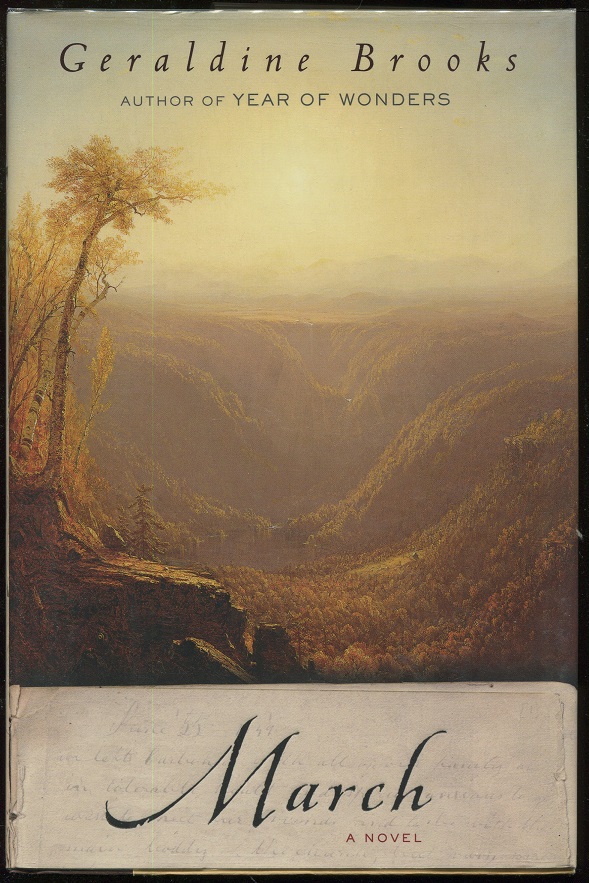
Hello, I’m Greg, and I’m obsessed with the Pulitzer Prize. I’m currently working on a project where I am reading (or rereading) all of the winners of the Pulitzer Prize for Fiction, and today we are going to talk about the strange case of Geraldine Brooks’s March, which won the 2006 prize.
I haven’t spent a lot of time in this era yet. Still, it’s a fun time to revisit because I was working at Borders, so I was very aware of books coming out. I had recently become obsessed with the Pulitzer Prize for Fiction, so I followed it closely (although I wasn’t yet attempting to predict it). So I remember there was a great deal of confusion when the Pulitzer Prize for Fiction was announced this year because the prize went to Geraldine Brooks for March and not the similarly titled book by E.L. Doctorow that most people had expected to be the favorite.
So what happened? In this deep dive, I’ll try to answer that question while discussing both March books–and I’ll offer my thoughts on whether the right March won.
Be warned: there will be spoilers. If you want to read the book first, maybe save this for later.
Snapshot: 2005
March won the Pulitzer Prize for Fiction in 2006, but because the Pulitzer is awarded the year after the eligibility period, it was published in 2005. That’s why we’re going to step into our little (imaginary) time machines to look back at was happening in 2005.
In bookstores: Perhaps the biggest book news of 2005 didn’t fully develop until 2006: in September of 2005, Oprah selected James Frey’s memoir A Million Little Pieces (which had been published in 2003) for her book club, blasting it across bestseller lists and into national conversation. In early 2006, reporting uncovered that Frey had fabricated details in his memoir, leading him to return to Oprah’s show for one of her most famous episodes, in which she had a showdown with him over facts and accuracy.
Outside of that, Publishers Weekly tells us the bestselling book of 2005 was John Grisham’s The Broker. The 2005 Nobel Prize in Literature went to Harold Pinter, “who in his plays uncovers the precipice under everyday prattle and forces entry into oppression’s closed rooms”. The Booker Prize went to The Sea by John Banville, and the National Book Award for Fiction went to Europe Central by William T. Vollmann.
In movies: The highest-grossing film of 2005 was Star Wars Episode III: Revenge of the Sith. Million Dollar Baby managed to pull off a Best Picture win at the Oscars over The Aviator, and in May of 2005, Crash was widely released. It would go on to infamously win Best Picture over Brokeback Mountain after a campaign that included a big push from Oprah.
In music: Mariah Carey had the best-selling album with “The Emancipation of Mimi,” while the Grammy for Album of the Year was posthumously awarded to Ray Charles for “Genius Loves Company,” an album filled with celebrity duets.
In the news: Importantly for our purposes, YouTube was launched. After more than 25 years as Pope, John Paul II died. He was succeeded by Pope Benedict XVI. And Hurricane Katrina made landfall in August, leading to more than a thousand deaths and an estimated $108 billion in damages.
What Is March About?
Geraldine Brooks takes Louisa May Alcott’s Little Women as inspiration. If you remember, Alcott’s classic story is a series of vignettes about the four March sisters (Meg, Jo, Beth, and Amy) as they come of age during the Civil War. They only have their beloved mother (called Marmee) to guide their life lessons because their father is away for the majority of the story, having enlisted in the Union army. In March, Brooks imagines the side of the story that belongs to the mostly absent father, Robert March. The book’s name is, of course, the protagonist’s surname, but it also plays on his role in the army and what the army does as it moves around.
Brooks sticks to Alcott’s basic framework, where the father writes heartfelt letters to his family and eventually returns home after becoming wounded (including Marmee’s brief visit to his bedside at the hospital before racing back home to tend to an ill Beth). But in Brooks’ telling, those heartfelt letters are obfuscations designed to prevent Marmee and his “little women” from knowing the traumas, disillusionment, and failures he is experiencing as the war rages on.
The inability to convey truth in letters is a recurring theme, first resulting in a sense of betrayal from Marmee when she discovers what the war has really done to her husband, and then complicity and understanding as she finds herself similarly unable to tell their daughters the gravity of her husband’s condition. In this way, Brooks casts Little Women, which is already understood to be a novel for younger readers, as an innocent version of this same story–although Brooks respects Little Women too much to go so far as to imply that it is naive. Instead, she shows us that Robert and Marmee are trying to preserve their daughters’ innocence. They don’t want them to face the realities of war and hardship for as long as possible. It allows for the notion that Little Women is able to be the sweet, idealized story that it is because the March sisters are living in a bubble that their parents are enforcing without their knowledge.
Brooks strays further from the source text by conflating the March family with Louisa May Alcott’s own, which is fair since Alcott did a bit of the same. The March sisters are inspired by Alcott herself and her own sisters. Jo is a stand-in for Louisa May Alcott while her sister Anna inspired Meg, May inspired Amy (which is especially fun because the fictional character’s name is an anagram of the real person), and her quiet sister Lizzie, who tragically died of complications from Scarlet Fever at the age of 23, inspired Beth.
In writing the story of the absent March father, Brooks took inspiration from Alcott’s father, Amos Bronson Alcott, a teacher, abolitionist, vegetarian, and transcendentalist. This is where things get tricky because using Alcott’s father as the inspiration for Robert March forces Brooks to move away from the source material. Her characterization of Marmee does not fit Alcott’s version, although she does offer a (slightly ham-handed) origin story to make sweet, kind Marmee square with Marmee’s admission to Jo that she’s angry every day. Brooks also makes the March family vegetarian, which I do not remember factoring into Little Women. She also makes the March family home a hub for the Underground Railroad and makes it clear that all of the daughters are aware of and actively participate in the caring and hiding of enslaved people. I have a hard time believing that the March sisters we know in Little Women would have had experiences like this (and, especially, that they would not find them worth sharing in their coming-of-age stories). It’s where the idea that Little Women reflects a bubble that the March sisters are living in bursts because both things cannot be true. They can’t be sheltered from the harsh realities of war while actively working as part of the resistance, presented with evidence of what slavery has wrought again and again.
In this way, there is a cognitive dissonance between the March family most of us know and love and the March family presented to us in this text. I’m not entirely convinced that it works in a satisfying way, but we’ll talk more about that later when we answer whether or not this book is good.
Why Was There Confusion About Which March Won?
The same year Geraldine Brooks released March, renowned American author E.L. Doctorow released The March. Aside from the similar titles, both are books about the American Civil War. The difference is that while Brooks made her March a retelling of Little Women, centered on the absent March father as he tries (and fails) to do good in the Union Army, Doctorow’s The March is about a large number of characters caught up in General Sherman’s devastating march across Georgia and the Carolinas, leaving a wake of destruction that helped bring the American Civil War to a close (and left large parts of the south a smoldering ruin).
I was working at a Borders at this time and remember there being a fair bit of confusion even before the Pulitzer announcement, but until that day when people asked for a book called March, they were mostly asking for E.L. Doctorow. Doctorow was a better-known author, his book was covered more, and that coverage was overwhelmingly positive. But interestingly, in bestowing the Pulitzer to Geraldine Brooks, the Pulitzer Board seems to have ensured that hers is the March that people are more likely to remember today.
Doctorow had established hefty literary credentials by this time, especially for his novels Ragtime and Billy Bathgate, but a Pulitzer had eluded him. He died in 2015 without a Pulitzer, but with a lasting place in the canon of American literature. In 2005 and 2006, he was the heavyweight contender while Geraldine Brooks was the newly emerging talent.
When The March began accumulating rapturous reviews, consensus quickly began to coalesce behind the idea that this was Doctorow’s time to capitalize on his credentials and win a slew of awards. Even the starred review from Kirkus that it received proclaimed, “Doctorow’s previous novels have earned multiple major literary awards. The March should do so as well.” The modern equivalent would be similar to Percival Everett releasing James in 2024 (although it remains to be seen if James will cross the Pulitzer finish line at the time I’m writing this. It has good odds, though).
But let’s stick with the critical reception for a moment. Here is how The Washington Post‘s review opened:
Rarely does one come across accounts of the Civil War as level-headed, generous and well-intentioned as E.L. Doctorow’s challenging new novel, The March. It might almost have been written as a corrective to the steady stream of poorly researched, sentimental romances of Southern gentility (and even, occasionally, steely-eyed Northern righteousness) that makes up the bulk of the genre.
“Scorched Earth,” a review by John Wray
Just to cause more confusion, the same could be said of Geraldine Brooks’s March, but she wasn’t getting the same headlines as E.L. Doctorow at the time. But there are significant differences in how Doctorow and Brooks approach their novels. We’ve already covered how Brooks framed her March, let’s allow The New York Times to sum up what Doctorow is up to in his March:
The rampant destructiveness of Sherman’s march is, of course, the stuff of high school textbooks, but what isn’t so obvious is the way that destruction transfigures and transforms, pulverizing established human communities and forcing the victims to recombine in new ones. Inside the churning belly of Doctorow’s beast, individuals shed their old identities, ally themselves with former foes, develop unexpected romantic bonds and even seem to alter racially. Yes, war is hell, and “The March” affirms this truth, but it also says something that most war novels leave out: hell is not the end of the world. Indeed, it’s by learning to live in hell, and through it, that people renew the world. They have no choice.
… War, for Doctorow, is a masquerade, a life-or-death circus of desperate opportunism that isn’t merely forgivable but mandatory. Pretending to be what one is not, concealing what one is, and devising a whole new self if necessary, is the legitimate animal response to overwhelming political violence. It may even be an integral component in cultural evolution.
“‘The March’: Making War Hell,” a review by Walter Kirn
It’s a great book. But it is, like the Brooks March, also a flawed book. The enormous scope of what Doctorow is doing makes finding something to latch onto difficult. The sheer number of characters is staggering, let alone the number of events they witness. It took me about 70 pages to find a rhythm that helped me wade along with Doctorow’s story, but I never felt truly settled into that rhythm; tides turned, rivers bent, waves crashed, etc. I admit, I was glad to know that I’m not the only person who struggled with this when, after finishing, I pulled up that review from The Washington Post I quoted earlier and read this: “Doctorow attempts to inhabit as wide a range of experience as possible, and to meet the peculiar demands of this ambition, the point of view shifts every few pages. This is where its greatest appeal and gravest weaknesses lie.” As an aside, I think it’s important to pay attention to The Washington Post and The New York Times in this discussion because the Chair of the Pulitzer Prize jury for that year was Marie Arana, the Book Editor for The Washington Post, and one of the jury members was Richard Eder, a book critic for The New York Times (although neither wrote the reviews I have quoted from their papers).
Back to Doctorow’s March: just as you think you’re getting to know a character well, Doctorow moves to another–or they die, or exit the story with little fanfare, or another character is introduced so when you do get back to this one, you have to remind yourself who they are. It’s hard to argue with it because the scope is the point. But it does make it difficult.
The confusion got worse when the Pulitzer announcement came, especially because although Geraldine Brooks’s March won, E.L. Doctorow’s The March was a finalist, so both books were tangled up in the announcement. I remember ringing customers up at the register in Borders who were purchasing Doctorow’s The March and commenting on how it had won the Pulitzer, then having to correct them and get them a copy of Brooks’s March for them to look at instead. Many people hadn’t even heard of Brooks’s novel, so when they heard that March won, they assumed it was the Doctorow novel they’d heard so much about. It was a wild time to work in a bookstore. I remember hearing somewhere at some point from some unknown source that even Geraldine Brooks attempted to correct the person who first told her that she had won, but I can’t find evidence of that online so take it with a grain of salt.
That is why there was so much confusion about the Pulitzer Prize for Fiction announcement in 2006. I read both March and The March to prepare for this deep dive, so later on we’ll talk about which one I think deserved to win (or if there was another contender who should have wiggled in).
How Did This March Win?
The proximity of The Washington Post and The New York Times to the awarding of the 2006 Pulitzer is an interesting example of how using reviews as a guidepost can be helpful or entirely misleading, and you just won’t know which one it is until you find out who wins. The review for Geraldine Brooks’s March in the Times (by Thomas Mallon) is very mediocre, including observations like “The whole mix-and-match affair proves more ingenious than interesting”, “Grace is only the most prominent among a whole set of slave saints and savants in Brooks’s novel”, and “The overall effect, quite unmitigated by a few African-American tokens of treachery, is treacly and embarrassing.” And The Washington Post didn’t even review Geraldine Brooks’s March at all.
Book prizes were similarly unhelpful because they almost entirely ignored Brooks’s March. However, E.L. Doctorow’s The March was a finalist for The National Book Award and won the PEN/Faulkner Award for Fiction and the National Book Critics Circle Award. It’s not the slew of awards that the Kirkus review predicted, but it was a respectable showing.
This is just to reiterate that it’s virtually impossible to predict the Pulitzer Prize for Fiction… and yet I keep trying.
E.L. Doctorow should have been an easy winner by all accounts, including the reviews (or lack of a review) from the major newspapers involved in making the decision. To hammer those relationships in, by the way, the Chairman of The Washington Post at the time, Donald E. Graham, was on the Pulitzer Board while Marie Arana, his editor for the book section, was on the fiction jury.
But I’m trying to apply reason to a process that frequently marches (ahem) to the beat of its own drum. Books that look like solid winners on paper frequently don’t end up winning the Pulitzer Prize for Fiction, and this is just one of those years.
At the end of the day, I can only speculate why Geraldine Brooks was chosen instead of E.L. Doctorow. To be honest, I don’t really feel comfortable doing that. The Pulitzer process has been very opaque for the last thirty years, so we may never know what made the Board lean toward Brooks. We don’t even know if the jury was allowed to make a specific recommendation to the Board because the amount of control the jury has over the process fluctuates. There are instances from less opaque years where we know the Board went against the jury’s recommendation in choosing a winner (it happened with Lonesome Dove in 1986 after the jury had recommended a different book), so it may not have mattered if the jury had input.
I did look at a copy of the third finalist for the Pulitzer in 2006, The Bright Forever by Lee Martin. I’ll talk more about that book later, but I wonder if the description on the back of the book offers a clue. It says, “His beautiful, clear-eyed, spartan prose builds to an extremely nuanced portrayal of the complicated give and take among people struggling to maintain their humanity in the shadow of loss.” I had been confused about how The Bright Forever, a book that flirts with elements of the mystery genre a la Mystic River, was listed alongside the March books, but this description reveals the throughline that most likely appealed to the jury, because those are qualities that are shared by March and The March. And if the jury was looking for a book that exemplifies maintaining your humanity in difficult times, it’s very possible they were more seduced by Brooks’s March. So maybe the Board followed the recommendation of the jury after all.
Sometimes, it’s easy to see how one book would seem more appealing to the Board with the benefit of hindsight. That’s not the case here. I’m grasping at straws.
Is This Novel Any Good?
I have mixed feelings about this question. March has some excellent attributes, yet there are also things that I just don’t think work.
For one thing, in the two novels by Geraldine Brooks that I have read, she has a confounding capacity for subtlety and restraint that suddenly veers into melodrama, cheapening the experience. In Year of Wonders, that spoiling melodrama is saved for the last fifty pages. In March, it’s much more embedded in the story. Most significantly, it comes out in Robert March’s relationship with an enslaved woman named Grace and how that forms an unexpected (and entirely unnecessary) love triangle that Marmee must also come to terms with when she rushes to her husband’s bedside and (surprise!) Grace has turned up again as his nurse in the hospital.
Grace herself is a clumsy character. She seems to exist to show what an enslaved person could have achieved with an education, but the way that is executed in the text feels both high-minded and ham-handed. In the Times review I quoted earlier, this is one of the more pointed critiques they identify: “Later in the action, after he has been sickened with fever and grazed by a rebel bullet, Grace again shows up, tending him in a Washington hospital and talking like a double major in civics and psychology: ‘He loves, perhaps, an idea of me: Africa, liberated. I represent certain things to him, a past he would reshape if he could, a hope of a future he yearns toward.'” She’s a symbol more than a realistic person. And it’s tough to believe that the towering symbol of Grace would fall for a wet noodle like Robert March. More on that in a moment.
The fact that the man who enslaved Grace was also her white father allows Brooks to get at hypocrisy and depraved cruelty in how white people treat the enslaved, or at least in how they dehumanize the enslaved while also fostering attractions to them. Things might not have been so bad had Grace just been a figure in Robert March’s past that he recalls, but the fact that she comes back into the story not once but twice feels contrived and forced.
The most confounding thing to me is that, despite being based on an arguably quite fascinating man, Robert March manages to be an uninteresting protagonist. He doesn’t feel like a man of iron principle so much as a well-intended sap who is spectacularly unfit for the realities of the world. There should be dramatic tension in the disconnect between March’s idealism and the depravities of war. It should feel devastating that he cannot connect with the soldiers and inspire them to see the nobility in their fight. Instead, he feels naive. He feels like a man only suited to intelligent society on the sidelines, where he can spread philosophical ideas in salons, through letters, or in published musings. He is not suited to grappling with the cold, hard realities that might make those ideas impossible to realize.
The problem with centering this story around such a weak protagonist is exacerbated when Marmee all-too briefly takes over the narrative when she visits a mostly comatose Robert March in the hospital. Her perspective (and her frustrations at wanting to enact change in the world while facing the restrictions of what women were allowed to say and do) is fiery and potent. But it’s all too quickly derailed by Brooks’ tendency toward melodrama, first in a somewhat clumsy revelation to the reader that March enlisted as a result of a complete and total misunderstanding of what his wife had wanted him to do, then because Marmee immediately susses out that there is some sort of past between her husband and Grace, and the rest of her brief storyline follows her as she investigates and comes to terms with it. By the time she reaches an uneasy resolution, it’s time for Marmee to return home and for Robert March to take over the narrative once again.
It makes me think that a Little Women retelling centered on Marmee rather than the absent father would have been much better. After reading Year of Wonders, I can attest that Brooks is exceptionally good at writing strong women suppressed by the constrictions of the time in which they live. A novel with Marmee’s reflections on the March family’s decline in fortune, the difficulties of raising her children alone in a time of war, and struggles to do good in her community and beyond would have been a lot more interesting (to me, at least). It would have required Brooks to stick to the structure of Little Women a lot more, but I think she’s talented enough to have met that challenge.
Knowing what I know about Geraldine Brooks and her husband, Tony Horwitz, I understand why the angle of telling the father’s story to incorporate Amos Bronson Alcott was more alluring to her. I’m just not convinced it works to the level that the Pulitzer jury and Board seem to think it does.
The Marmee interlude did alleviate some of my feelings about Robert March being naive, especially when she thinks, “And I knew then that I loved this man. This inconstant, ruined dreamer.” But it doesn’t do enough to allay all of my issues.
Perhaps telling Robert March’s story would have worked better for me if Brooks had incorporated a more raw, adult version of the vignettes that frame Little Women. A more episodic structure that moves from one situation portraying an aspect of the war to another would have allowed Brooks to shade in all the complexity she wants to get at without making March’s ramblings and self-doubt so heavy by the end of the novel (in addition to being a fun nod to the structure of the source text).
I’ve complained a fair amount, but there are good parts, too. Brooks is very nuanced and understanding when it comes to the idealism of the Civil War’s purpose and the stark reality (and pervasiveness) of racist attitudes at the time. She also understands that the commonly accepted purpose (eliminating slavery) was not a motivating factor for every Northern citizen. One of the recurring themes in the book is that Union soldiers are very capable of cruelty toward the enslaved and the recently freed that they encounter. And it isn’t just cruelty toward black people, it’s also cruelty toward southerners. In this manner, March is also something of a moral treatise on how people act when they have the upper hand (although I don’t think there’s enough content on this notion to adequately call it a theme).
If war can ever be said to be just, then this war is so; it is action for a moral cause, with the most rigourous of intellectual underpinnings. And yet everywhere I turn, I see injustice done in the waging of it. And every day, as I turn to what should be the happy obligation of opening my mind to my wife, I grope in vain for words with which to convey to her even a part of what I have witnessed, what I have felt. As for what I have done, and the consequences of my actions, these I do not even attempt to convey.
Page 65
In the end, March is more about facing the sense of futility that often comes with trying to change the world for the better. And maybe that’s why Robert March feels like a wet noodle. Ultimately, it’s more important to this narrative that he feels defeated by the end, as though all his work has been for nothing. He has to rediscover his confidence and faith in himself (and the world) before returning home to Marmee and their little women. And Marmee must lead him there, as she does in this exchange after her husband has revealed the depths of his perceived failings (including his inability to kill a Confederate soldier, leading to the deaths of many people on March’s own side):
“I valued my principles more than I valued their lives. And the outcome is, they are slaves again, or dead.”
“You are not God. You do not determine the outcome. The outcome is not the point.”
“Then what, pray, is the point?” His voice was a dry, soft rattle, like a breeze through a bough of dead leaves.
“The point is the effort. That you, believing what you believed–what you sincerely believed, including the commandment ‘thou shalt not kill’–acted upon it. To believe, to act, and to have events confound you–I grant you, that is hard to bear. But to believe, and not to act, or to act in a way that every fiber of your soul held was wrong–how can you not see? That is what would have been reprehensible.”
Pages 258-259
And while I have complained about the unnecessary quality of Grace’s love triangle with the March family, she does play a key role in the conclusion that points toward a deeper understanding of race relations and intersectionality than you might expect from a novel published in 2005:
“When I am a little stronger I could work with you: there will be needs, great needs, when colored troops are enlisted at last–“
She cut me off again, angrily this time.
“We have had enough of white people ordering our existence! There are men of my own race more versed in how to fetch and carry than you will ever be. And there are Negro preachers aplenty who know the true language of our souls. A free people must learn to manage its own destiny… If you sincerely want to help us, go back to Concord and work with your own people. Write sermons that will prepare your neighbors to accept a world where black and white may one day stand as equals.”
Page 268
Writing all this out has been a rollercoaster for me, first revealing that my problems with the text run deeper than I had thought, then discovering more to appreciate in Brooks’ intent (or in how I interpret it, at least). I think the problem I’m facing here is that I want to like March more than I actually do, because I admire the creative force Brooks brought to this story and the care she took in researching and crafting it. I do think she made some poor decisions in that process and succumbed to some of her lesser instincts as a writer by allowing unnecessary melodramatic elements. I admire her intentions a great deal, but to me, March is a flawed book. So all I can really say is that this is a good but not great work of historical fiction.
Who Is Geraldine Brooks? What Inspired Her to Write March?
To get to know Geraldine Brooks, I highly recommend reading her recent memoir (called Memorial Days) about her marriage to Tony Horwitz (and her grief over his sudden death). It’s a particularly good way to get to know her because her marriage to Horwitz shaped her writing career in powerful ways.
She was born in Australia and moved to the United States after meeting Horwitz at Columbia University’s Graduate School for Journalism–the same school that administers the Pulitzer Prizes, which both Brooks and Horwitz would win in their careers (she for fiction, he for national reporting). For years, both worked as foreign correspondents, reporting from some of the most dangerous places to report from in the 1990s.
The first book Brooks published (in 1994) was a nonfiction account of her experiences among Muslim women in the Middle East called Nine Parts of Desire, and it was a bestseller.
But when it came time to start a family, Brooks and Horwitz moved away from working as foreign correspondents and settled in Virginia. Horwitz continued to work as a journalist while Brooks faced a conundrum: how could she continue to work as a writer while dedicating herself to raising their sons? In Memorial Days, Brooks details how it was Horwitz who encouraged her to write fiction, resulting in her first novel, 2001’s Year of Wonders, which bears the dedication “For Tony. Without you, I never would have gone there.”
She retains Australian citizenship but became an American citizen in 2002, making her eligible for the Pulitzer Prize for Fiction.
March was her second novel, and it too owes a debt to Brooks’s relationship with Horwitz, who had become what Brooks described as a “Civil War bore,” dragging her and their sons around while researching his astonishing nonfiction book Confederates in the Attic: Dispatches from the Unfinished Civil War (incidentally, one of my favorite nonfiction books, and the one I credit with showing me that not all nonfiction is boring). Here is what I think is an adorable passage to end her afterword in March:
In the nineteenth year of our own union, I retract unreservedly my former characterization of my husband, Tony Horwitz, as a Civil War bore. Further, I would like to apologize for all the times I refused to get out of the car at Antietam or whined about the heat at Gettysburg; for all the complaints about too many shelves colonized by his Civil War tomes and all the moaning over weekend expeditions devoted to events such as the interment of Stonewall Jackson’s horse. I’m not sure quite when or where it happened, but on a sunken road somewhere, I finally saw the light.
In that afterword, she also details how she used information from Amos Bronson Alcott’s life and adapted them using other historical details (and reveals that she chose to open March with the battle of Ball’s Bluff “simply because the terrain of that small but terrible engagement lies just a few miles from my Virginia home.”
Since winning the Pulitzer, Brooks has gone on to publish four more novels (People of the Book, Caleb’s Crossing, The Secret Chord, and Horse) in addition to the aforementioned memoir, Memorial Days.
Is March the Great American Novel?
Since the Pulitzer Prizes were created to legitimize America and its contributions to journalism and the arts, the Fiction Prize feels uniquely tied to the quest for The Great American Novel (I have a whole other post about that). The simple answer here is that while it has merits, I do not think March would be part of that conversation.
What Was March‘s Competition for the Pulitzer?
Obviously, we’ve already covered E.L. Doctorow’s The March, which was a finalist, at great length. The other finalist is inexplicable to me: The Bright Forever by Lee Martin. I mentioned it briefly earlier but didn’t say that I read The Bright Forever after it became a finalist in 2006. In my memory, it was deeply just okay. While the copy on the dust jacket offers a clue, it’s difficult to see how it ended up a finalist.
The only other real contenders I can see are Mary Gaitskill’s Veronica and Cormac McCarthy’s No Country for Old Men. Veronica is the more likely contender of the two because similar to Doctorow’s The March, it was eating up a lot of critical oxygen in 2005 (and like The March, it was a finalist for the National Book Award). I don’t remember hearing much about No Country for Old Men until after McCarthy released The Road, which went on to win him the Pulitzer–and which was released around the time the film adaptation of No Country was announced.
There are slim pickings beyond that. There may have been a push for Extremely Loud & Incredibly Close by Jonathan Safran Foer, but there were enough detractors that I don’t think it would have been a serious threat. The History of Love by Nicole Krauss also drew some critical attention, but I don’t see it as much of a contender for the Pulitzer.
Should March Have Won the Pulitzer Prize for Fiction?
Had I been in charge, I would probably have swapped Lee Martin out for McCarthy among the finalists, but I wouldn’t have given McCarthy the win. I read Veronica when it was published and remember it being a miserable reading experience. I considered rereading it for this deep dive but timing got the better of me, and I admit I feel reluctant to return to that book given my first impression of it.
That leaves me with a battle of the March books. That’s not an entirely satisfying outcome since I find flaws in each. I wish 2005 had offered me an option I could feel more confident about. But I have greater difficulty reconciling my problems with Geraldine Brooks’s March than with E.L. Doctorow’s The March. And while I find it imperfect, I can’t help but admire the scope and ambition of Doctorow’s vision. Of the two books, I think Doctorow’s is the one that will leave more of an impression on me in time. In my world, therefore, General Sherman would have marched his army right over Robert March to snatch victory and reckon with the chaos left behind later.
In other words: yes, the wrong March won.
Other Pulitzer Prize Deep Dives
His Family (1918) • Now in November (1935) • Gone With the Wind (1937) • The Grapes of Wrath (1940) • To Kill a Mockingbird (1961) • The Color Purple, Alice Walker (1983) • Lonesome Dove (1986) • Interpreter of Maladies (2000) • Tinkers (2010) • Less (2018) • The Netanyahus (2022) • TIE: Trust and Demon Copperhead (2023) • Night Watch (2024)
Deep Dives On Pulitzer Years With No Winner
 Supposedly Fun