I’m not a reader who typically jumps into a longlist, but for whatever reason, there are a couple of books on the 2025 Booker Prize longlist that jumped out to me. I don’t know if I’ll get to all of them before the shortlist is announced (or even before the winner is announced), but I thought it would be fun for a change to do the Booker thing and post reviews of the books I do end up reading. Who knows, maybe this will end up being the only one. We’ll find out!
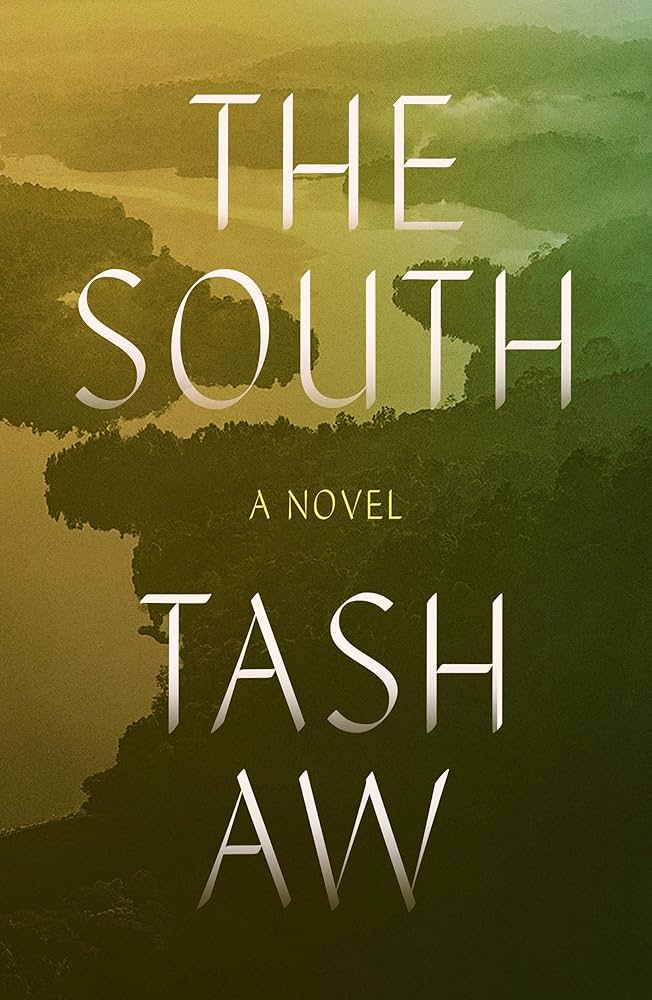
The first book that I grabbed was The South by Tash Aw. I think what most stood out to me when going through the longlist was the queer angle (that this is a coming-of-age first-love story between two teenage boys living in Malaysia in 1997). If you know me, you know that’s catnip for my soul. On top of that, here’s the blurb that serves as an elevator pitch for this novel: “A radiant, intimate novel of the longing that blooms between two boys over the course of one summer—about family, desire, and what we inherit.” So we have longing between two boys, a family story, a story about desire, and a story about what we inherit from our families. Check, check, check, and check. Those are all things I am interested in reading about.
To get a bit more granular about what this book is about (without spoilers), our most central character is Jay, the sixteen-year-old son of a family that is, if not on the brink of collapse, then at least approaching it quite rapidly. Jay’s older sisters, Lina and Yin, tell him that their parents have been fighting and divorce is a very real possibility. Perhaps because he’s the baby of the family (or perhaps because he’s the only son), Jay has no EQ for what’s going on in his own family. That’s a bit indicative of who Jay is as a person: people have to spell out what’s happening for him, and even when presented with evidence, he doesn’t exhibit any curiosity, interest, or capacity to figure anything out for himself.
Anyway, Jay’s grandfather has recently passed away. In a bit of a surprise move, he left a plot of land he owns in the south of the country (ahem, we have a title) to Jay’s mother instead of his son, who had wanted to sell the land off as soon as he had rights to it. Jay’s mother insists that the family go to the land while on break. Why she’s so determined to go is a mystery. Restlessness for a change of scenery due to her stifling marriage? To save the farm (if you can call it that) from continuing to waste away? To establish a permanent residence for herself, away from her husband? All of the above?
Jay and his family arrive on the farm and displace the actual residents, Fong and Chuan. Fong is his father’s half-brother, a product of a long romance between Jay’s grandfather and his mistress. Of course, that means that Chuan is his cousin, but The South appears not to want you to think about that at all. Since Fong is the illegitimate son, his relationship to his brother is more like that between an employee and his disinterested benefactor. While Jay and his family have known a comfortable life, Fong and Chuan have had a much more hardscrabble existence–and Chuan has grown to resent his father for his inability to succeed.
Jay quickly becomes obsessed with Chuan. He begins to spend his days working on the land with Chuan and waiting up in the night to see if he will return to sleep on the makeshift bed he has been relegated to while Jay sleeps in Chuan’s bed. As Jay and Chuan grow closer, Jay explores life outside the well-mannered existence he has heretofore known.
Humming in the backdrop of this domestic story is the world at large. Tash Aw does not make specific references to news items or political events (indeed, he barely mentions the name of the country they are in at all), but through context clues, we can place the action during the Asian financial crisis of 1997. This is a world that is familiar and relatable to modern readers in the United States or the U.K. Jay mentions that some of his classmates have disappeared from the school due to bankruptcy, leaving upside-down chairs in their place to form silent memorials. Prices have gone up and made food and goods largely unaffordable. Businesses have shuttered, unable to survive the economic climate. The farm, plagued by drought, has become useless, and no matter how hard Fong works to fix it, it becomes clear that his stubbornness may actually be foolishness. Surrounding land has alternately been repurposed or abandoned mid-transformation.
This is the best aspect of The South: its capacity to show how deeply crises like this impact rural life, or how people like Fong and Chuan perpetually exist at the mercy of forces outside of their control. Sure, Jay faces his own uncertain future, but it’s also true that he is a visitor in this landscape–a spectator playing around with living Chuan’s life.
Connectivity is a concern throughout the novel, signified (metaphorically, at least) by numerous instances where characters are unable to hear what someone else is saying.
It’s also interesting how Tash Aw plays with memory and knowability. Jay’s mother, Sui, has returned to this land largely because of her memories of time spent there. The reality of the place and what it has become is far more complex. And as the perspective and narrative style shift throughout the book, it seems an older version of Jay is framing this story for us.
Given that The South is the first in a planned quartet of novels, it feels safe to assume that readers will eventually get to meet this older version of Jay. But in the meantime, Jay has his own fixation on memories–creating them and memorializing events in real time. More than Chuan, Jay is aware that these events will someday be a memory.
But overall, I found The South to be a mostly unsatisfactory reading experience. The shifting perspectives, the way the voice shifts to first person and away again, the tricky chronology–it all feels unnecessarily complicated to me. And I don’t think The South ever really establishes any stakes. Perhaps Tash Aw intends to do more of that in future volumes, but I don’t feel as though I’ve been given any reason to return to this universe or wonder what happens to its characters. I had forgotten that this book is the first in a quarter when I started reading, and when I was reminded, all I could think was “Really?” It doesn’t feel like a book that is launching a series.
And though I am willing to concede that my next complaint may be the result of saving material for later volumes, I was also irritated by how Tash Aw creeps up to heavier conversations but backs away before actually engaging with them. Take the relationship between Jay and Chuan: the reader can infer that they are cousins, but Aw never says anything about it–or the implications of a sexual relationship between them. In fact, it feels that Tash Aw would do anything rather than actually discuss it, so he structures the story in a way that discourages the reader from thinking about it, too.
The same is true for every plot strand of this book. Anything interesting about Chuan’s troubled friend Jessie is ultimately left unsaid. Tash Aw leaves clues, but steadfastly avoids revelation. The reader can infer what’s happening, but there’s nothing to do with that information in the end.
The South approaches weighty topics without actually getting into them. Maybe Tash Aw is saving that for subsequent volumes in the series, but that really just means that this one feels unsatisfying.
You can probably guess, then, that if I were in charge of things, I wouldn’t have put The South on a longlist. I do think it has a good shot at making the shortlist, but if it does, I’m not going to be impressed. For me, this is an unfulfilled promise of a book. Maybe when you get to the end of book four, it will all mean something, but it doesn’t right now.
When it comes to other longlisted books, I have a copy of Endlings on its way and I was just granted access to The Land in Winter on NetGalley. I’m also on a hold list for Flesh and Love Forms at my local library. And I’m waiting rather impatiently to see if I can get early access to The Loneliness of Sonia and Sunny or if I’m going to have to wait for the publication date. I have copies of Flashlight and Audition, but I don’t think I’m going to prioritize those. If I do end up reading all of those, it would be 8 titles off the longlist. I don’t expect that to happen, though. I’m too much of a mood reader. So I’ll just ask you which ones you think I should prioritize and we’ll see what I actually get to reading.
 Supposedly Fun
Do Endling and Audition next. I read Audition and really liked it. Would love to discuss it.
LikeLike