Hi, My name is Greg, and if you know me, you know that I have two big obsessions in life: the Pulitzer Prize for Fiction and the Academy Awards. And we’re not here to talk about the Oscars today, which means it’s time to guess what will win the Pulitzer Prize for Fiction in 2026. We’re less than a month away from the announcement on May 4 at 3 pm Eastern, and I just can’t wait. This is one of my favorite things to do every year.
In truth, this is a fool’s errand. To try to predict the Pulitzer, you have to make a stab in the dark. It’s the only major literary prize with no longlist and no list of finalists in advance. You do not know which books are under consideration. You don’t even know who the jury is because the Pulitzer Board prefers them to remain anonymous until the prize is announced (essentially to prevent campaigning. I have a whole video about it). You only get one shot to get it right, and you don’t get any hints. That does make it fun… but it also makes it a bit infuriating.
There aren’t even any consistent indicators for what might be on its way to a win. Sometimes, the ALA Notable Titles are helpful, but more often, they aren’t. Sometimes, the PEN/Faulkner longlist gives you a good idea, but most of the time, it doesn’t (and the winner of the PEN/Faulkner almost never lines up with the Pulitzer). The most consistent indicator is that the Pulitzer winner usually has a starred review from Kirkus, Publishers Weekly, or both. But a lot of books can claim that status, so you still have a lot of options.
This year is particularly difficult to parse. Last year, we had a runaway frontrunner in Percival Everett’s James (even though the jury did try to overlook him). It doesn’t feel like we have much of a frontrunner this time, although I did identify two. There’s also the fact that a lot of the possibilities flout the Pulitzer’s mandate that says the prize should go to “an American author, preferably dealing with American life.” Many contenders don’t really have a connection to the United States at all. Many contenders have authors who currently live in the United States but weren’t born here and are not typically thought of as “American” authors.
You can imagine, then, that putting together a prediction for the 2026 winner was not easy for me.
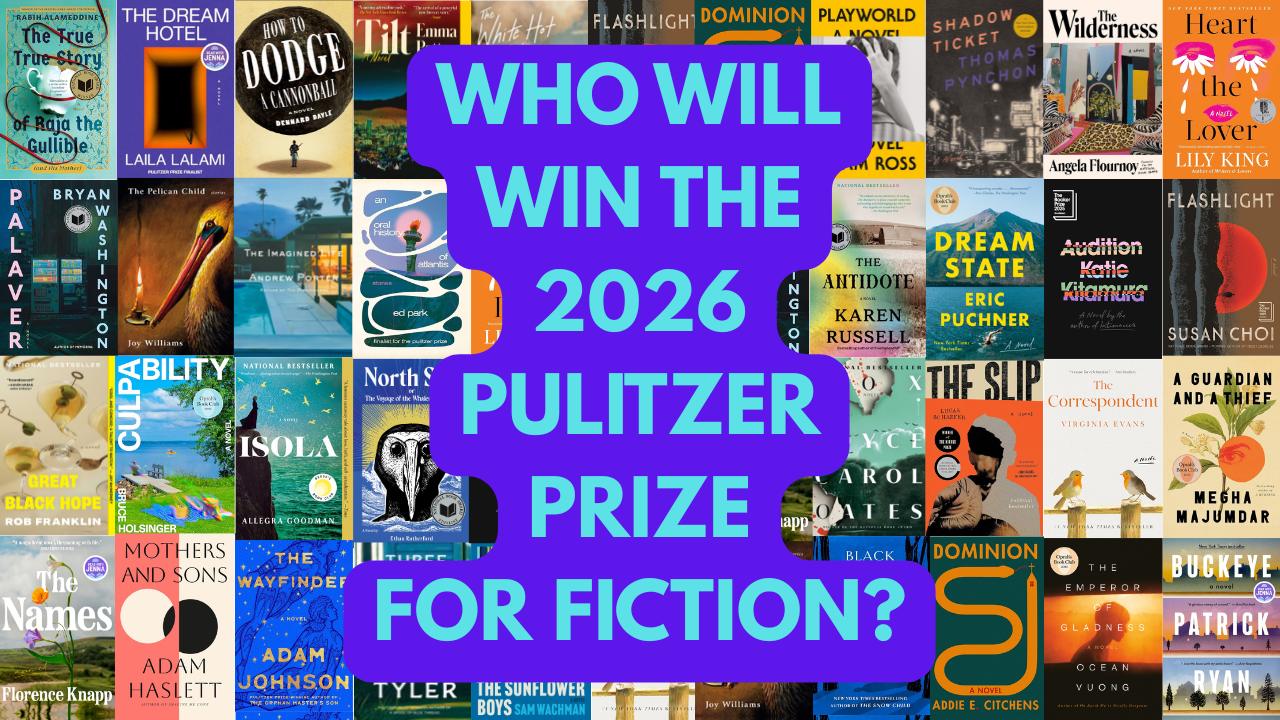
First, I’ll explain how the Pulitzer Prize for Fiction is awarded. Then we’ll go in this order: the books I think are frontrunners, the books that might be strong contenders, authors who have been finalists in the past who might be in the mix again, potential surprise winners, some lovable longshots, and finally: my prediction.
How It Works
The first thing to know is that when we talk about the Pulitzer Prizes for 2026, we are talking about work released in 2025. Like the Academy Awards, the Pulitzers are awarded after the submission period (AKA the calendar year) has ended.
The Pulitzer Board is very secretive and insular, so we don’t know what the current process for selection is, but the basic format is the same as when the Pulitzer Prize originated. A jury is named for each category. They go through the submissions. We don’t get to know who the jury is until the prize is announced (again, this is to prevent authors or publishers from campaigning, as far as I can tell). The jury narrows it down to finalists–usually three. They do not get to pick a winner. Historically, the jury was allowed to recommend to the Board which title they thought should win, and the Board could either go with their choice or go rogue. Again, the process is murky, but as recently as 2012, it did not appear that the jury was allowed to make a specific recommendation to the Board anymore. They could only present the finalists with an explanation for why each title was selected. If the Pulitzer Board is dissatisfied with what they have been presented, they can request an additional finalist or ask the jury why a specific title was not presented to them. That definitely came into play last year.
The Board could also opt not to award any prize at all–although this is unlikely to happen again (or at least any time soon) after the controversy that came in 2012 when the Board failed to select a winner. The Board can also decide to have no winner if they fail to reach a majority decision. A book needs at least 50% of the Board to vote for it to win. But clearly, since the Board allowed a tie in 2023, they have made some adjustments in that area.
This selection process isn’t entirely unlike how it works for the Booker or the Women’s Prize, but in those cases, the jury has significantly more control over the outcome. For the Pulitzer, the Board has the final say.
The Pulitzer also has a mandate that needs to be considered, although how it is applied can be very murky: “For distinguished fiction published in book form during the year by an American author, preferably dealing with American life.” Different juries and Boards have had very different interpretations of how much (or how little) each part of that mandate needs to be considered. I could spend a lot of time listing instances where they bent the rule about publication (Train Dreams in 2012, had been published in The Paris Review ten years before it arrived in book form), the part about dealing with American life (The Orphan Master’s Son in 2013, which is entirely set in North Korea), and that the prize should go to an American (Carol Shields had immigrated to Canada when she won for The Stone Diaries, which was a finalist for the Booker Prize the same year–in an era when Americans weren’t supposed to be eligible for the Booker), but I’ll leave it at those three examples.
The citizenship requirement was also recently expanded to include longtime and permanent residents of the United States. It had previously required the winner to be an American citizen. Citizenship has always been a murky requirement to unpack (again, look at the case of Carol Shields), so it is unclear if this will make a difference–or how much.
The Frontrunners
These are the books that feel most likely to triumph. But take that with a massive grain of salt because sometimes the Pulitzer likes a surprise more than recognizing the book most people think will win. Last year was a curious combination of the two scenarios: while the jury tried to avoid frontrunners completely, the Board managed to get around that.
Flashlight, Susan Choi
From the blurb: “Flashlight spans decades and continents in a spellbinding, heart-gripping investigation of family, loss, memory, and the ways in which we are shaped by what we cannot see.”
- National Book Award for Fiction longlist
- Carnegie Medal for Excellence in Fiction longlist
- Washington Post‘s 50 Notable Books of 2025
- Time Magazine’s 100 Must-Read Books of 2025
- Booker Prize finalist
- Women’s Prize for Fiction longlist
- The New Yorker‘s Best Books of 2025
- Previous Pulitzer Prize finalist
Pros: The publisher sure seems confident, scheduling the paperback edition for publication the day after the Pulitzer announcement. Flashlight is one of two American books that have shared the majority of adulation from 2025. It’s also navigated a bittersweet minefield in that it’s been up for major literary prizes without actually winning any. I often believe that the Pulitzer doesn’t like a winner to have fingerprints from other prizes on it by the time they announce their winner. Susan Choi has also been a Pulitzer finalist before, so she’s someone who is familair to the Board. On paper, that plus the impressive pedigree of ‘Best’ lists and starred reviews make Flashlight look like a solid bet.
Cons: Immediately, we’re running into the issue of how the jury will interpret their mandate to preferably reward a book that deals with American life. A lot of Flashlight takes place in Japan and North Korea, and it deals significantly more with immigration, identification, and assimilation between those countries. Even though parts of it do take place in the United States, it doesn’t feel like an American book. If the jury and Board want to reward Flashlight, they’ll have to decide to overlook this. There’s also the surprising lack of a starred review from both Kirkus and Publishers Weekly.
Audition, Katie Kitamura
From the blurb: “An exhilarating, destabilizing Möbius strip of a novel that asks whether we ever really know the people we love.”
- Starred review from Kirkus
- Starred review from Publishers Weekly
- A Publishers Weekly Best Book of 2025
- National Book Critics Circle Award for Fiction finalist
- Time Magazine’s Best Books of 2025
- Time Magazine’s 100 Must-Read Books of 2025
- Washington Post‘s 50 Notable Books of 2025
- Kirkus Best Fiction of 2025
- Joyce Carol Oates Prize finalist
- Booker Prize finalist
- Women’s Prize for Fiction longlist
- Carol Shields Prize for Fiction longlist
- The New Yorker‘s Best Books of 2025
Pros: Audition has been toe to toe with Flashlight for months, and actually has an even more impressive pedigree of ‘Best’ lists, starred reviews, and prize longlists. Like Flashlight, it hasn’t won any of those prizes, which could make it feel more fresh to the Pulitzer jury and Board. But unlike Flashlight, Audition doesn’t have the problem of dealing with American life. It’s not a book that’s making statements about America, but it is set entirely within its borders.
Cons: Even without winning one of those other literary prizes (yet), it feels like Audition has been everywhere. Not to the level of James last year, but still. If the jury and Board want to lift up a book most people missed, the answer will not be Audition. Plus, I think the Pulitzer has settled into a pattern of late where one year, they’ll recognize a frontrunner and the next they’ll go for something overlooked. That’s bound to end sometime, but if the Board wants to follow the pattern, this is a bad year to be a frontrunner.
Strong Contenders
It won’t necessarily be surprising if any of these books win, but each has some mark against it that, to me, also means it won’t be surprising if they don’t win.
Heart the Lover, Lily King
From the blurb: “Heart the Lover is a deeply moving love story that celebrates literature, forgiveness, and the transformative bonds that shape our lives.”
- Starred review from Kirkus
- National Book Critics Circle Award for Fiction longlist
- Pen/Faulkner Award for Fiction finalist
- New York Times 100 Notable Books of 2024
- Washington Post‘s 50 Notable Books of 2025
- Time Magazine’s Best Books of 2025 (ranked first)
- Time Magazine’s 100 Must-Read Books of 2025
- Joyce Carol Oates Prize longlist
- Women’s Prize for Fiction longlist
- ‘Also Recommended’: The New Yorker‘s Best Books of 2025
Pros: There are often narratives for Pulitzer winners where they’ll have some minor successes with critical acclaim for one or two books, then win for a book you didn’t necessarily see coming. My classic example of this is Jeffrey Eugenides, who got recognition for his debut,The Virgin Suicides that hadn’t translated into much other than a film adaptation that also didn’t make many waves. When his second book, Middlesex, came out, he ended up winning a Pulitzer. That’s Lily King, except that Heart the Lover is King’s sixth novel (with an additional collection of short stories). 2014’s Euphoria was her breakout, landing her on the New York Times Book Review‘s 10 Best Books of the Year. 2020’s Writers and Lovers continued her rise, and now with Heart the Lover she’s poised to start raking in acclaim. That could make Lily King the stealth Pulitzer contender to watch out for. And her sublime, intelligent prose would fit in the Pulitzer family of authors remarkably well.
Cons: The book is great, but I worry that if it were to win, people would start complaining that it feels slight for a Pulitzer book. It’s not “timely” or “urgent” for anyone who wants literature that makes a capital-S Statement.
A Guardian and a Thief, Megha Majumdar
From the blurb: “Megha Majumdar paints a kaleidoscopic portrait of two families, each operating from a place of ferocious love and undefeated hope, each discovering how far they will go to secure their children’s future as they stave off encroaching catastrophe.”
- Starred review from Kirkus
- Starred review from Publishers Weekly
- Carnegie Medal for Excellence in Fiction winner
- National Book Award for Fiction finalist
- New York Times 100 Notable Books of 2024
- Washington Post‘s 50 Notable Books of 2025
- Kirkus Prize finalist
- Time Magazine’s Best Books of 2025
- Time Magazine’s 100 Must-Read Books of 2025
- Women’s Prize for Fiction longlist
- Carol Shields Prize for Fiction longlist
- ‘Also Recommended’: The New Yorker‘s Best Books of 2025
- Oprah’s Book Club pick
Pros: The pedigree is pretty insane, putting A Guardian and a Thief on par with the two books I designated frontrunners: Flashlight and Audition. Plus, Megha Majumdar would also fit the mold I just described for Lily King: her previous novel, A Burning, was a more quietly acclaimed success.
Cons: We’re back to the question of how the jury and Board will interpret the part of the mandate that prefers a book that deals with American life. But while Flashlight follows American citizens with ties to Japan and North Korea, A Guardian and a Thief follows a family that is desperately trying to immigrate to the United States. Will that be enough?
The Wilderness, Angela Flournoy
From the blurb: “A generational talent, [Flournoy] captures with disarming wit and electric language how the most profound connections over a lifetime can lie in the tangled, uncertain thicket of friendship.
- Starred review from Kirkus
- Starred review from Publishers Weekly
- A Publishers Weekly Best Book of 2025 (expanded fiction list)
- National Book Critics Circle Award for Fiction finalist
- National Book Award for Fiction longlist
- A Washington Post Best Book of 2025
- Kirkus Prize finalist
- Time Magazine’s 100 Must-Read Books of 2025
- The New Yorker‘s Best Books of 2025
Pros: I didn’t realize that putting these three books in a row followed a theme, but here we go: Angela Flournoy also received a good amount of critical acclaim for her debut, The Turner House, and her new book has her poised for even bigger success. And her sublime, intelligent prose would fit in the Pulitzer family of authors remarkably well, too.
Cons: I say it every year: a black woman hasn’t won the Pulitzer Prize for Fiction since Toni Morrison in 1988. That’s almost 40 years, and it’s not for a lack of compelling candidates. If it’s taken that long for the Pulitzer to recognize a black woman, will they go for a book so inextricably tied to representation of black women? I mean, they should, but will they?
The Slip, Lucas Schaefer
From the blurb: “Bobbing and weaving across the ever-shifting canvas of a changing country, The Slip is an audacious, daring look at sex and race in America that builds to an unforgettable collision in the center of the ring.”
- Starred review from Kirkus
- ALA Notable Title
- New York Times 100 Notable Books of 2024
- A Washington Post Best Book of 2025
- Kirkus Prize winner
- Kirkus Best Debut Fiction of 2025
Pros: This book just keeps surprising, especially when it won the Kirkus Prize–beating out The Wilderness, A Guardian and a Thief, Flesh (which won the Booker Prize), and other heavy hitters from 2025. The pedigree indicates that it could cross the finish line…
Cons: … But will it? It’s classified literary fiction, which is the Pulitzer’s wheelhouse, but the plot being centered on a missing person calls to mystery elements. Will that make it a tough sell to the Board? Plus, the blurb also compares Lucas Schaefer to Jonathan Franzen and Nathan Hill–two authors who have not won a Pulitzer. That’s me being a bit cheeky, but I do wonder if The Slip would be more likely to only make it as far as being a finalist.
Previous Finalists
Having been a finalist for the Pulitzer before isn’t necessarily an indication that a win is only a matter of time, but it does mean these authors have been on the radar of past juries. Sometimes, it’s even true that an author who is presented to the Board more than once can get weighted more heavily. That’s how the Pulitzer Board decided on Anne Tyler over Raymond Chandler when Tyler was up for a third time.
Shadow Ticket, Thomas Pynchon
“Late Pynchon at his finest. Dark as a vampire’s pocket, light-fingered as a jewel thief, Shadow Ticket capers across the page with breezy, baggy-pants assurance — and then pauses on its way down the fire escape just long enough to crack your heart open.” —The Los Angeles Times
- Starred review from Publishers Weekly
- New York Times 100 Notable Books of 2024
- Washington Post‘s 50 Notable Books of 2025
- Time Magazine’s 100 Must-Read Books of 2025
Pros: If the jury and Board want to recognize an author’s legacy, Pynchon would be a good place to start looking. He’s a storied American author who, at 88, won’t be giving the Pulitzer many more chances to recognize him. And the way he didn’t win back when he was a finalist was pretty awful because the jury recommended Gravity’s Rainbow for the win and the Board, which thought it was obscene, declined to give a prize at all rather than see it go to Pynchon. If they want to atone for the past, this could be their chance. Maybe even their last one?
Cons: What I just said is pretty much the entire case for why Shadow Ticket is a contender. If he does win, everyone would know that it’s a lifetime achievement award instead of recognition for this book.
Fox, Joyce Carol Oates
From the blurb: “Written in Oates’s trademark intimate, sweeping style, and interweaving multiple points of view, Fox is a triumph of craftsmanship and artistry, a novel as profound as it is propulsive, as moving as it is full of mystery.”
- Starred review from Kirkus
- Starred review from Publishers Weekly
- A Publishers Weekly Best Book of 2025 (expanded fiction list)
Pros: Joyce Carol Oates is the Susan Lucci of the Pulitzer Prize. She’s been a finalist four times, most recently in 2015. She’s an American literary icon who’s been incredibly prolific since her first book was published in 1964. At age 87, the Board won’t have too many more times to recognize her if it wants to.
Cons: There’s an element here where I wonder if Oates’ prolific writing is a detriment. Even at her age, there’s a temptation to say “there’s always next year.” Plus, Oates has leaned hard into her obsession with crime and brutality in recent years. As with The Slip, the jury and Board would have to choose a literary fiction book that dabbles in crime literature. There’s even blood spatter on the cover design. Lastly, just like Shadow Ticket and Thomas Pynchon, if this wins everyone will know it was in recognition of Oates’ career and not for this specific book.
The Pelican Child, Joy Williams
“An American master is back with crystalline stories that map the personal and political minefields of her unmoored characters. Williams blends everyday dramas with surreal imagery, her voice and range inspiring awe.” —Boston Globe
- Starred review from Kirkus
- Starred review from Publishers Weekly
- Kirkus Best Fiction Book of the Year
- Washington Post‘s 50 Notable Books of 2025
- PEN/Jean Stein Book Award finalist
Pros: Joy Williams is like Jayne Anne Phillips, who won for Night Watch in 2024: a writer whose name may not be too recognizable to the public, but who is quite well known and celebrated among writers and critics. Her starred review in Kirkus even proclaimed that “Williams should be next in line for the Nobel Prize in Literature.” It’s not hard to believe that a jury would put her forward.
Cons: This feels like something that a jury would present as a finalist only for the Board to choose something else. In recent years, short story collections have been finalists, but they’ve uniformly lost to the novel in the group. Someday, a short story collection will get through–and Joy Williams does feel like an author who could do that–but it feels so unlikely that you have to assume that it won’t happen. There’s also a smaller concern about whether or not the Board would respond to the experimental nature of Williams’ writing.
The Antidote, Karen Russell
From the blurb: “Russell’s novel is above all a reckoning with a nation’s forgetting—enacting the settler amnesia and willful omissions passed down from generation to generation, and unearthing not only horrors but shimmering possibilities.”
- Starred review from Kirkus
- Starred review from Publishers Weekly
- National Book Critics Circle Award for Fiction finalist
- National Book Award for Fiction finalist
- Washington Post‘s 50 Notable Books of 2025
- Time Magazine’s 100 Must-Read Books of 2025
- PEN/Jean Stein Book Award longlist
Pros: When Michael Cunningham explained why the jury he was on selected Karen Russell’s debut, Swamplandia!, as a finalist in the infamous year where the Board failed to choose a winner, he noted that they did it in recognition of a bold new literary talent, foreseeing a great career ahead for her. While her subsequent releases had smaller receptions, The Antidote marks a return to the literary forefront. Set during the Dust Bowl, it also checks the box about dealing with American life, but it also aims to speak to the present moment.
Cons: There are what you might call “eccentric” elements to this book, chief among them a “Prairie Witch” who holds memories and secrets from other people. The jury went with the eccentricities of Swamplandia! (even if the Board did not). Will they do it again for The Antidote, which promises to be even more out there?
The Dream Hotel, Laila Lalami
From the blurb: “Eerie, urgent, and ceaselessly clear-eyed, The Dream Hotel artfully explores the seductive nature of technology, which puts us in shackles even as it makes our lives easier. Lalami asks how much of ourselves must remain private if we are to remain free, and whether even the most invasive forms of surveillance can ever capture who we really are.”
- Starred review from Kirkus
- Starred review from Publishers Weekly
- ALA Notable Title
- Washington Post‘s 50 Notable Books of 2025
- Time Magazine’s 100 Must-Read Books of 2025
- ‘Also Recommended’: The New Yorker‘s Best Books of 2025
- A Read With Jenna book club pick
Pros: Living in a time where big tech companies are putting our privacy up for sale, The Dream Hotel earned high praise from critics and readers for serving as a sort of rallying cry that it isn’t too late to set boundaries.
Cons: It’s the dystopian angle. The Board accepted Cormac McCarthy’s The Road, but would the it respond to a book that sounds like it has elements of Minority Report throughout? Genre books struggle to get recognition in general, but sci-fi appears to be a nonstarter for the Pulitzer.
Mothers and Sons, Adam Haslett
From the blurb: “A mother and son, estranged for years, must grapple with the shared secret that drove their lives apart in this enthralling story about family, forgiveness–and how a fleeting act of violence can change a life forever.”
- Starred review from Kirkus
- Starred review from Publishers Weekly
- Washington Post‘s 50 Notable Books of 2025
Pros: The pedigree for this book may be slight, but the blurbs and critical quotes are almost uniformly from the type of person who could be on a Pulitzer jury (and some who already have been).
Cons: Still, it’s hard to be enthusiastic about this book’s odds given how slight its profile is.
An Oral History of Atlantis, Ed Park
From the blurb: “Spanning a quarter century, these sixteen stories tell the absurd truth about our lives. They capture the moment when the present becomes the past—and are proof positive that Ed Park is one of the most imaginative and insightful writers working today.”
- Starred review from Publishers Weekly
- Pen/Faulkner Award for Fiction longlist
- Time Magazine’s 100 Must-Read Books of 2025
Pros: Like Mothers and Sons, the pedigree leaves a lot to be desired–but this book’s inclusion on the Pen/Faulkner Award for Fiction longlist is intriguing. And while juries change every year, Ed Park did manage to become a finalist before. Maybe he can do it again?
Cons: For one thing, it’s short stories. For another thing, it leans toward sci-fi. Just one of those things would make for a very tough hill to climb. Two feels insurmountable. And then there’s also the notion that yes, Ed Park was nominated before, but since the jury will be different, it doesn’t stand to reason that it will happen again. Even if he did land among the finalists, it feels pretty certain the Board wouldn’t pick him for the win (again).
Black Woods, Blue Sky, Eowyn Ivy
From the blurb: “The author of the Pulitzer Prize finalist The Snow Child returns to the mythical landscapes of Alaska with an unforgettable dark fairy tale that asks the question: Can love save us from ourselves?”
- An NPR and Seattle Times best book of the year
Pros: I think it’s a great book. Eowyn Ivy surprised us with her first Pulitzer Prize finalist. Maybe she can do it again?
Cons: My enthusiasm for this book aside, I don’t think there’s any realistic chance of this winning. The fact that it missed every single watch signal I use to evaluate contenders is staggering. I had to reach just to find something to call out as a pedigree.
Potential Surprise Winners
These books can claim the pedigree of strong contenders, but each has something that makes them feel like more of a long shot. If they win, it will feel like an incredible come-from-behind story.
The Correspondent, Virginia Evans
From the blurb: “Discover the word-of-mouth hit hailed by Ann Patchett as ‘A cause for celebration’—an intimate novel about the transformative power of the written word and the beauty of slowing down to reconnect with the people we love.”
- Carnegie Medal for Excellence in Fiction longlist
- Washington Post‘s 50 Notable Books of 2025
- Center for Fiction First Novel Prize longlist
- Women’s Prize for Fiction longlist
Pros: It’s possible for beautiful, quiet, deeply observant books to win a Pulitzer for Fiction (Anne Tyler comes to mind again, as well as Elizabeth Strout), and The Correspondent would be a perfect fit.
Cons: There’s quite often more of an emphasis on capital-L Literature for awards like the Pulitzer Prize. And there can be a fair bit of snobbery as well. The fact that The Correspondent was a word-of-mouth smash could make it feel “commercial” to a Pulitzer jury. Is that fair? No. Is it real? Yes.
Isola, Allegra Goodman
From the blurb: “Inspired by the real life of a sixteenth-century heroine, Isola is the timeless story of a woman fighting for survival.”
- Starred review from Kirkus
- New York Times 100 Notable Books of 2024
- Kirkus Prize finalist
- Washington Post‘s 50 Notable Books of 2025
- Time Magazine’s 100 Must-Read Books of 2025
- Reese’s Book Club pick
Pros: People who liked this book really seemed to like it, and seem willing to evangelize about it whenever possible.
Cons: A win entirely depends on one of those people being on the jury–and on the Board. And when historical fiction wins, it’s usually connected to capital-A American moments in history (the Civil War being perhaps the biggest). It feels like a bit of a long shot.
The Emperor of Gladness, Ocean Vuong
From the blurb: “Following the cycles of history, memory, and time, The Emperor of Gladness shows the profound ways in which love, labor, and loneliness form the bedrock of American life.”
- Starred review from Kirkus
- Starred review from Publishers Weekly
- ALA Notable Title
- Carnegie Medal for Excellence in Fiction longlist
- Time Magazine’s 100 Must-Read Books of 2025
- ‘Also Recommended’: The New Yorker‘s Best Books of 2025
- Oprah’s Book Club pick
Pros: With a critically acclaimed novel to his name (On Earth We’re Briefly Gorgeous) and success as a poet, Ocean Vuong is primed for recognition from a major book prize. The critical and financial success of The Emperor of Gladness hasn’t gotten him there yet, but maybe the Pulitzer will take the leap.
Cons: Then again, it’s a bit surprising that this book hasn’t shown up on any longlists. Maybe that’s a bad sign. It could come down to the same “commercial” problem I mentioned with The Correspondent, compounded here by the presence of that big “O” on the jacket. Sure, Demon Copperhead had one, too, but the critical praise heaped on that book combined with the fact that Barbara Kingsolver was a decades-renowned American author made that moot. I have a theory that book club picks largely inspire the kind of literary people likely to be on the Pulitzer jury to turn up their noses. Vuong would have to overcome all that. But to be fair, if any book club is going to get around that, Oprah’s seems most likely.
Buckeye, Patrick Ryan
From the blurb: “‘A glorious sweep of a novel’ (Ann Patchett) that weaves the intimate lives of two midwestern families across generations, from World War II to the late twentieth century.”
- Starred review from Publishers Weekly
- New York Times 100 Notable Books of 2024
- Washington Post‘s 50 Notable Books of 2025
- Joyce Carol Oates Prize longlist
- A Read With Jenna book club pick
Pros: Buckeye feels tailor-made for the Pulitzer’s guidance to preferably reward a book that deals with American life. It also has a lot of blurbs and praise from high-profile writers, indicating that Ryan has some clout in the industry. If any of those fans are on the jury, he could at least get in as a finalist. Ryan would also fit in nicely alongside Richard Russo (who blurbed the book) in the Pulitzer family of authors.
Cons: Oprah’s Book Club has Pulitzer winners (although most of them were after the fact), so she might be able to get around book club stigma. Can a book with a “Read With Jenna” sticker? And even some reviews that praise Buckeye mention that it’s overly long and slow. A large part of the appeal in Buckeye seems to depend on the reader making it to the conclusion. I didn’t, and I’ve heard from many other readers who also didn’t make it.
The Sunflower Boys, Sam Wachman
From the blurb: “A harrowing and gorgeous tale of love, identity, lost innocence, and survival set in a time of devastating war, The Sunflower Boys is a powerful, heartrending exploration of young queer love, the Ukrainian spirit, and a family’s struggle to survive.”
- Starred review from Kirkus
- Starred review from Publishers Weekly
- ALA Notable Title
- Washington Post‘s 50 Notable Books of 2025
Pros: If this year’s jury (and Board) are into the idea of making a statement of support for Ukraine and the LGBTQIA+ community, this is the best way to do that. Plus, praise for this book is rather effusive.
Cons: The pedigree is slight, as is the book’s profile. It could be easy to get distracted by other, flashier titles.
The White Hot, Quiara Alegría Hudes
From the blurb: “The story of a runaway mother’s ten days of freedom—and the pain, desire, longing, and wonder we find on the messy road to enlightenment—from Pulitzer Prize winner Quiara Alegría Hudes.”
- Starred review from Kirkus
- Starred review from Publishers Weekly
- Pen/Faulkner Award for Fiction finalist
- Kirkus Best Debut Fiction of 2025
Pros: Yes, you heard that correctly: Quiara Alegría Hudes is already a Pulitzer Prize-winner in the drama category. That shows she has what it takes to cross the finish line. The fact that at least some Board members are familiar with her work could give her a leg up.
Cons: … If she makes it as far as getting presented to them. She would have to be nominated by the jury, and the pond for Fiction is a lot bigger than the pond for Drama.
Dominion, Addie E. Citchens
From the blurb: “A brilliantly crafted Black Southern family drama told with the captivating force, humor, and tenderness carried in the hearts of these women, Addie E. Citchens’s Dominion wrestles with the many brutal, sinister ways in which we are shaped by fear and patriarchy, and studies how we might yet choose to break free.”
- Starred review from Kirkus
- Starred review from Publishers Weekly
- Pen/Faulkner Award for Fiction finalist
- Women’s Prize for Fiction longlist
Pros: Most people who read this book are evangelists about it (pun intended). The fact that it’s on the longlist for the Women’s Prize for Fiction and a finalist for the Pen/Faulkner Award show it has what it takes to be in the mix for a major book award.
Cons: I keep falling back on the idea that if the jury puts this forward, it would be more likely to be a finalist and not a winner. There’s also that troubling fact that a black woman hasn’t won in almost forty years.
Palaver, Bryan Washington
From the blurb: “Written with understated humor and an open heart, moving through past and present and across Houston, Jamaica, and Japan, Bryan Washington’s Palaver is an intricate story of family, love, and the beauty of a life among others.”
- National Book Award for Fiction finalist
- Washington Post‘s 50 Notable Books of 2025
- Time Magazine’s 100 Must-Read Books of 2025
- Joyce Carol Oates Prize longlist
- ‘Also Recommended’: The New Yorker‘s Best Books of 2025
Pros: Palaver‘s status as a National Book Award finalist could indicate that Bryan Washington is entering a new stage of his literary career.
Cons: From the feedback I’ve gotten, Washington’s work is still pretty love-it-or-hate-it. If the jury has mixed feelings about it, it probably won’t make it as a finalist.
Great Black Hope, Rob Franklin
From the blurb: “A gripping debut from an electrifying new voice about an upwardly mobile and downwardly spiraling Black man caught between worlds of race and class, glamorous parties and sudden consequences, a friend’s mysterious death and his own arrest.”
- Starred review from Kirkus
- ALA Notable Title
- Carnegie Medal for Excellence in Fiction longlist
- Kirkus Best Debut Fiction of 2025
- Time Magazine’s 100 Must-Read Books of 2025
Pros: Great Black Hope‘s inclusion in the ALA Notable list and the longlist for the Carnegie Medal for Excellence in fiction show a surprising level of strength. Telling a story about a black man trapped by questions of race, class, and the justice system is quite a compelling hook.
Cons: The feedback I’ve gotten from subscribers has been pretty mixed-to-negative. I also wonder if the elements of the plot description sound like they lean a bit into being a crime novel, which would cause Great Black Hope to run into the genre problem.
Playworld, Adam Ross
From the blurb: “Less a bildungsroman than a story of miseducation, Playworld is a novel of epic proportions, bursting with laughter and heartache. Adam Ross immerses us in the life of Griffin and his loving (yet disintegrating) family while seeming to evoke the entirety of Manhattan and the ethos of an era—with Jimmy Carter on his way out and a B-list celebrity named Ronald Reagan on his way in. Surrounded by adults who embody the age’s excesses—and who seem to care little about what their children are up to—Griffin is left to himself to find the line between youth and maturity, dependence and love, acting and truly grappling with life.”
- New York Times 100 Notable Books of 2024
- Washington Post‘s 50 Notable Books of 2025
- ‘Also Recommended’: The New Yorker‘s Best Books of 2025
Pros: This is another case where the people who like this book absolutely seem to love it. It’s also a case where the voluminous blurbs about the book come from a lot of literary types who could easily be on the Pulitzer jury. Focusing the plot in the New York City of 1980 is a popular way to meet the “preferable dealing with American life” mandate, and novels centering on a disintegrating families have been catnip for previous Pulitzer juries and Boards.
Cons: Without having read the book, it’s difficult for me to gauge how likely this is to emerge victorious. Sight unseen, it seems like Playworld could make it as a finalist in the vein of Elif Batuman’s The Idiot, Andrew Sean Greer’s Less, and Donna Tartt’s The Goldfinch. But I wonder if the Graduate-esque relationship, the satirical edge the premise implies, and the B-list celebrity of it all would land with a jury.
Dream State, Eric Puchner
From the blurb: “Written with humor, precision, and enormous heart, both a love letter and an elegy to the American West, Dream State is a thrillingly ambitious ode to the power of friendship, the weird weather of marriage, and the beauty of impermanence.”
- Starred review from Kirkus
- Joyce Carol Oates Prize longlist
- ‘Also Recommended’: The New Yorker‘s Best Books of 2025
- Oprah’s Book Club pick
Pros: There’s no denying that Dream State deals with American life. It also deals with the climate crisis, a buzzy topic in recent years for many literary prizes (including the Pulitzer). The complicated story of family, betrayal, forgiveness, and friendship at the center also feels primed for the Pulitzer Prize. And as we discussed earlier, if any book club is going to get around book club stigma, it’s Oprah’s.
Cons: I read this one and, to be honest, I really didn’t like it. I thought it was too long, not very compelling, and I really didn’t get along with the overly-complicated structure. Obviously, I’m not on the Pulitzer jury, so my opinion can only go so far. But I see this as a book that has the veneer of serious issues without actually saying much about them. Maybe a veneer is enough, but I hope it isn’t.
Culpability, Bruce Holsinger
From the blurb: “Culpability explores a world newly shaped by chatbots, autonomous cars, drones, and other nonhuman forces in ways that are thrilling, challenging, and unimaginably provocative.”
- Starred review from Kirkus
- Washington Post‘s 50 Notable Books of 2025
- ‘Also Recommended’: The New Yorker‘s Best Books of 2025
- Oprah’s Book Club pick
Pros: If the Pulitzer wants to make a statement about how technology (including AI) is reshaping our lives, this would be a good direction to move in.
Cons: I would feel more confident predicting that if Culpability had more indicators–the ALA Notable list, any book prize longlist, etc.
The Sisters, Jonas Hassen Khemiri
From the blurb: “Narrated in six parts, each spanning a period ranging from a year to a day to a single minute, Jonas Hassen Khemiri’s The Sisters is a big, vivid family saga of the highest order—an addictively entertaining tour de force.”
- Starred review from Publishers Weekly
- A Publishers Weekly Best Book of 2025
- Pen/Faulkner Award for Fiction finalist
- National Book Award for Fiction longlist
- Joyce Carol Oates Prize longlist
- The New York Times Book Review‘s Best Books of 2025
- New York Times 100 Notable Books of 2024
- Carnegie Medal for Excellence in Fiction longlist
- The New Yorker‘s Best Books of 2025
Pros: The pedigree is solid, hitting a lot of potential indicators. Its fans are smitten. The authors who have blurbed the book are impressive. I was initially concerned about this being another of those books that are too international to meet the Pulitzer’s mandate, but I have been told that the book is set in Sweden and in the United States.
Cons: Maybe it still feels too international? The indicators are here, but is the vibe?
Previous Winners
It’s exceptionally rare for a writer to win more than one Pulitzer Prize for Fiction. Only four people have done it (Booth Tarkington, William Faulkner, John Updike, and Colson Whitehead). So, there’s a steep uphill climb for these authors to win again. To be honest, I don’t think it’s likely that we’ll see anyone join that exclusive club this year.
Wayfinder, Adam Johnson
From the blurb: “Evoking the grandeur of Wolf Hall and the splendor of Shōgun, the Pulitzer Prize–winning novelist Adam Johnson conjures oral history, restores the natural world, and locates what’s best in humanity.”
- Starred review from Publishers Weekly
- A Publishers Weekly Best Book of 2025 (expanded fiction list)
Pros: Johnson’s first Pulitzer win was for a novel that you wouldn’t expect to fit the mold of a Pulitzer book, so who’s to say he doesn’t have more surprises up his sleeve?
Cons: Those second wins are so rare. I can’t see it happening for Johnson, especially for a book that’s much more about Tonga than the United States.
Three Days in June, Anne Tyler
From the blurb: “Told with deep sensitivity and a tart sense of humor, full of the joys and heartbreaks of love and marriage and family life, Three Days in June is a triumph, and gives us the perennially bestselling, Pulitzer Prize–winning writer at the height of her powers.”
Pros: I think you could make a more solid case for Anne Tyler getting a second win than you could with Adam Johnson based on these books.
Cons: … but it still feels very unlikely to happen. When Tyler won her Pulitzer, she was a much bigger name in the literary world. She’s still a big name, to be fair, but her new books aren’t an event like they used to be. Plus, the pedigree is nonexistent.
Lovable Longshots
Is there a chance that one of these books will win the Pulitzer? Sure. Is it likely? Not really.
The Loneliness of Sonia and Sunny, Kiran Desai
From the blurb: “The Loneliness of Sonia and Sunny is the sweeping tale of two young people navigating the many forces that shape their lives: country, class, race, history, and the complicated bonds that link one generation to the next. A love story, a family saga, and a rich novel of ideas, it is the most ambitious and accomplished work yet by one of our greatest novelists.”
- Starred review from Kirkus
- Starred review from Publishers Weekly
- The New York Times Book Review‘s Best Books of 2025
- New York Times 100 Notable Books of 2024
- Washington Post‘s 50 Notable Books of 2025
- Kirkus Prize finalist
- Booker Prize finalist
- Time Magazine’s 100 Must-Read Books of 2025
- The New Yorker‘s Best Books of 2025
Pros: It’s certainly one of the most acclaimed books from 2025.
Cons: Listen, I don’t think this one is likely, but Kiran Desai has lived in New York City for a while, so I feel like I need to include this just in case that meets the U.S. residence criteria for the Pulitzer.
Endling, Maria Reva
From the blurb: “A darkly comic novel, Endling draws on Reva’s own experiences as a Ukrainian expat tracking her family’s delicate dance of survival behind enemy lines. As fiction and reality collide on the page, she probes the hard truths of war: What stories must we tell ourselves to survive? Once shattered, can our sense of normalcy and security ever be restored?”
- Starred review from Kirkus
- Starred review from Publishers Weekly
- A Publishers Weekly Best Book of 2025 (expanded fiction list)
- Booker Prize longlist
- ‘Also Recommended’: The New Yorker‘s Best Books of 2025
Pros and Cons: I’m just going to tell you that this is the same deal as The Loneliness of Sonia and Sunny: it looks like Maria Reva lives in Austin, TX, so I feel like I need to include this just in case.
The True True Story of Raja the Gullible (and His Mother), Rabih Alameddine
From the blurb: “Told in Raja’s irresistible and wickedly funny voice, the novel dances across six decades to tell the unforgettable story of a singular life and its absurdities–a tale of mistakes, self-discovery, trauma, and maybe even forgiveness. Above all, The True True Story of Raja the Gullible (and His Mother) is a wildly unique and sparkling celebration of love.”
- Starred review from Publishers Weekly
- National Book Award for Fiction winner
- Time Magazine’s 100 Must-Read Books of 2025
- ‘Also Recommended’: The New Yorker‘s Best Books of 2025
Pros: People who love The True True Story of Raja the Gullible seem to really love it.
Cons: Winners of the National Book Award rarely coincide with the Pulitzer. It happened last year, but that’s because James was in that rare class of book that feels undeniable, which is when a crossover usually does happen. Plus, the book doesn’t feel particularly “American,” so the jury and Board would have to push the boat out to choose this.
The Imagined Life, Andrew Porter
From the blurb: “Rich in atmosphere, and with a stunningly sure-footed emotional compass, The Imagined Life is a probing, nostalgic novel about the impossibility of understanding one’s parents, about first loves and failures, about lost innocence, about the unbreakable bonds between a father and a son.”
- Carnegie Medal for Excellence in Fiction longlist
- Joyce Carol Oates Prize longlist
- ‘Also Recommended’: The New Yorker‘s Best Books of 2025
Pros: Not for nothing, this was one of my favorite reads from last year. Porter’s writing reminded me of someone who did take home a Pulitzer: John Cheever.
Cons: I don’t actually think there’s much of a shot for this to win, but a guy can dream. In my world, it would be much more of a contender.
North Sun: Or, the Voyage of the Whaleship Esther, Ethan Rutherford
From the blurb: “An allegory of extraction and a tale of adventure and endurance during the waning days of the American whaling industry. With one foot firmly planted in the traditional sea-voyage narrative, and another in a blazing mythos of its own, this debut novel looks unsparingly at the cost of environmental exploitation and predation, and in doing so feverishly sings not only of the past, but to the present and future as well.”
- Starred review from Kirkus
- National Book Award for Fiction finalist
Pros: The case here is that in recent years, a book that popped up on the National Book Award’s radar (but didn’t win) has ended up winning the Pulitzer–even if, like Night Watch, it didn’t have much else in terms of pedigree to indicate that it was a contender.
Cons: The difference is Night Watch had an author who was quietly beloved by many people in the industry. I don’t know if Rutherford can match that.
The Names, Florence Knapp
From the blurb: “The book’s brilliantly imaginative structure, propulsive storytelling, and emotional power are certain to make The Names a modern classic.”
- Starred review from Kirkus
- Starred review from Publishers Weekly
- Carnegie Medal for Excellence in Fiction longlist
- A Read With Jenna book club pick
Pros: It’s a great book from a talent to watch.
Cons: There’s an undeserved opinion that The Names is overly sentimental. I love it, but many people haven’t taken this book seriously, so it could be a steep uphill battle.
How to Dodge a Cannonball, Dennard Dayle
From the blurb: “How to Dodge a Cannonball is a razor-sharp satire that dives into the heart of the Civil War, hilariously questioning the essence of the fight, not just for territory, but for the soul of America. Uproariously funny and revelatory, How to Dodge a Cannonball asks if America is worth fighting for. And then answers loudly.”
- Starred review from Kirkus
- Starred review from Publishers Weekly
- New York Times 100 Notable Books of 2024
Pros: The Pulitzer does love books about the Civil War.
Cons: Satires? Not as much. Plus, this flew way under the radar. It’s possible a jury member could lift it up, but there are a lot of books that could happen for.
Tilt, Emma Pattee
From the blurb: “Tilt is a ‘moving adrenaline rush’ (The New York Times Book Review) and ‘epic odyssey’ (NPR) about the disappointments and desires we all carry, and what each of us will do for the people we love.”
- Starred review from Kirkus
- Starred review from Publishers Weekly
- Carnegie Medal for Excellence in Fiction longlist
- Time Magazine’s 100 Must-Read Books of 2025
- ‘Also Recommended’: The New Yorker‘s Best Books of 2025
Pros: I initially wondered if the recommendations I’ve gotten for this book are more indicative of audience enthusiasm than critical, literary establishment street cred, but being on the longlist for the Carnegie Medal for Excellence could show that it has both.
Cons: It still feels unlikely to me, unless the jury for this year wants to make a statement about the climate crisis (although there are other ways to do that).
Twist, Colum McCann
From the blurb: “Resoundingly simple and turbulent at the same time, Twist is a meditation on the nature of narrative and truth from one of the great storytellers of our times.”
- Starred review from Kirkus
- Starred review from Publishers Weekly
- A Publishers Weekly Best Book of 2025 (expanded fiction list)
Pros: The entire case here is that Colum McCann has been quietly beloved for almost two decades now, since Let the Great World Spin won the National Book Award.
Cons: As beloved as he is, McCann hasn’t had any presence with the Pulitzer up to now. Maybe that will change, but if he didn’t get closer for his bigger hits, does it seem reasonable to expect him to get close now? Plus, this is yet another book that doesn’t feel American.
Only Son, Kevin Moffett
From the blurb: “With wit and compassion, Moffett delivers a bracingly intimate account of fatherhood, and discovery, and the experiences of two men far from home.”
- Starred review from Kirkus
- National Book Award for Fiction longlist
Pros: The entire case here is that maybe being on the National Book Award longlist is the only indicator, a la Night Watch.
Cons: That’s pretty much the only case to be made here.
Small Ceremonies, Kyle Edwards
From the blurb: “A poignant and heart-wrenching coming-of-age story that follows the friendships, hopes, fears, and struggles of a group of Native high school students from Winnipeg, Manitoba’s North End, illuminating what it’s like to grow up in the heart of an Indigenous city.”
- ALA Notable Title
Pros: The plot and the author are very Canadian. But Kyle Edwards is a Provost Fellow at USC, and the Canadian-American line has been blurred by the Pulitzer before.
Cons: That feels like a big stretch.
Sacrament, Susan Straight
- Starred review from Kirkus
- Joyce Carol Oates Prize longlist
Pros: I don’t really know why, but it’s stuck in my head that Susan Straight could be a stealth candidate for a Pulitzer.
Cons: That appears to be entirely in my own head (so far).
The Lilac People, Milo Todd
- ALA Notable Title
Pros: I’ve seen this title floated as a potential dark horse several times in the Pulitzer Discord I’m a member of.
Cons: It feels like this would be a little too surprising.
People Like Us, Jason Mott
- Starred review from Kirkus
- Carnegie Medal for Excellence in Fiction longlist
- Time Magazine’s 100 Must-Read Books of 2025
Pros: After his National Book Award win for his previous novel, Jason Mott’s star could be on the rise.
Cons: Maybe this book is a bit too meta? And if so much of the book is a meta version of Mott winning a National Book Award, will the Pulitzer respond?
The Girls Who Grew Big, Leila Mottley
- Carnegie Medal for Excellence in Fiction longlist
- ‘Also Recommended’: The New Yorker‘s Best Books of 2025
Pros: Leila Mottley’s debut, Nightcrawling, set her up as a talent to watch–and her new novel may have a slight pedigree, but it may have the one that counts in the Carnegie Medal longlist.
Cons: It still feels like a huge longshot.
My Prediction
I’ve really struggled to get a handle on what could happen this year. I often think that, in any given year, the prize is, in some way, a reaction to the prior year, but the 2025 Pulitzer Prize is an unusual case. The jury tried to do an end run around James and recognize something else, but the Board exercised its power to request an additional finalist.
What’s the direction to go after that? In the end, we did get one of the year’s most popular and critically acclaimed books as the winner. So, do I predict that this year’s winner will be a known, recognizable entity? Or will this year’s jury double down on their predecessor’s intention to avoid a book seen as a frontrunner?
On top of that, there’s the blurriness of what constitutes a frontrunner this time around. The closest we have to it is Flashlight and Audition, but both feel more vulnerable than James did. Still, if you want to make a safe bet, choosing one of them is your best option.
I’m thinking that this is a good year for one of two things: either the jury gets to take advantage of a muddy year to give it to an author who’s been unrecognized before, or we’ll get something that isn’t in that top tier of frontrunners, but which would still be recognizable to most readers who follow book news.
If the former, we need to take a serious look at Thomas Pynchon and Joyce Carol Oates. Joy Williams could be a possibility, but I still think the fact that her contender is a short story collection will hurt its chances of actually winning. Of Pynchon and Oates, I think Pynchon would be more likely, but if this is the avenue the jury is going to take, I think they’re more likely to go the less obvious route. That would mean that the other previous finalists (Susan Choi, Karen Russell, Laila Lalami, Adam Haslett, Ed Park, and Eowyn Ivey) are the most likely. Susan Choi puts you right back with the frontrunners, so maybe Flashlight? If not her, I think Karen Russell is the next most logical guess, followed by Laila Lalami. Lalami is only really hampered by her novel’s proximity to dystopia.
If the latter, I’m really tempted to go with either Heart the Lover or The Wilderness. But if this is the path the jury is taking, they might be more tempted to go further down the list, which would probably be good news for The Correspondent, Buckeye, The Emperor of Gladness, Playworld, Dominion, or Culpability.
Do you see how I keep getting lost here?
Further complicating things, Jonathan from the Pulitzer Discord group I’m in, made the following observation about the Carnegie Medal for Fiction Longlist: “since first introduced in 2012 (the no-Pulitzer year) only two eventual Pulitzer winners were not on the Long List, and both are seen by many as terrible choices: NIGHT WATCH and THE NETANYAHUS. These two aside, we have 12 Pulitzer winners that were on the Carnegie Long List.”
Taking a look at the Carnegie Medal for Excellence in Fiction longlist for this year and omitting books that wouldn’t be eligible, I see Flashlight, The Correspondent, Great Black Hope, The Sisters, The Names, A Guardian and a Thief, These Heathens, People Like Us, The Girls Who Grew Big, Tilt, The Imagined Life, The Emperor of Gladness, and Good Dirt by Charmaine Wilkerson.
Once again, Flashlight is shining in my face like I’m under police interrogation. But I just feel like I can’t commit to it because it’s so international. And it’s so obvious. Same with A Guardian and a Thief.
From that list, I’m also not ready to commit to Great Black Hope, People Like Us, The Girls Who Grew Big, Tilt, Good Dirt, and (reluctantly) The Imagined Life.
That leaves me with The Correspondent, The Names, The Sisters, These Heathens, and The Emperor of Gladness. I’m tempted to go for the full wildcard and say I predict These Heathens, but other than the Carnegie Medal longlist, there are no indicators to make me feel confident about it. But maybe that’s a good thing? Or maybe I should just lean into either The Correspondent or The Emperor of Gladness. But both are bestsellers–The Correspondent thanks to word of mouth and The Emperor of Gladness thanks to Oprah. Maybe they aren’t low profile enough? And The Names was a major book club pick.
It’s difficult to figure out which direction to go in when you think there’s a good chance the winner will be a lesser-known book because there are so many lesser-known books. It would help to know who’s on the jury, but we don’t.
Here’s where I’m (finally) coming down: the only book left from the Carnegie Medal for Excellence longlist is The Sisters. And ultimately, that book meets the criteria I’ve been thinking about. It’s got a perfect pedigree for a Pulitzer winner, but I’m willing to bet that it’s not very well-known outside of literary circles. Even in literary circles (specifically, my channel and the people who comment on my videos), I don’t know many people who have read The Sisters yet. Perhaps for good reason, because it is a brick of a book at 656 pages.
So maybe that’s the solution to my problem. The Sisters has a pretty perfect balance of recognition and obscurity for a year where I’m feeling like the jury will take advantage of a somewhat hazy year to get something more obscure, out-there, or just less obvious.
Look, the possibilities are endless and overwhelming. I could be on a totally incorrect path here. I’m currently listening to the audio of Dominion by Addie E. Citchens and, depending on how it all works out, it would be a really interesting pick for a left-field winner. So would Playworld, which I haven’t read yet. And hey, Adam Haslett has been a two-time finalist, so maybe the third time will be the charm and he’ll bring it home for Mothers and Sons. And maybe I should predict The Wilderness, because I do think it has a chance, and I would personally love to see Angela Flournoy win a Pulitzer.
Or, it could be three finalists and a winner that I’m completely overlooking.
Or, I could stick to what’s safe and choose between Audition and Flashlight.
I’m going to do something new this year. For the first time, I’m going to try to predict the finalists–and then I’ll choose my winner from there. This could be absolute folly on my part, but this whole endeavor is folly anyway. So here goes.
My guess at the finalists:
- The Pelican Child, Joy Williams
- The Sisters, Jonas Hassen Khemiri
- Heart the Lover, Lily King
Let’s run down how I’m going to choose my prediction from those three.
Joy Williams would be a great choice if the jury wants to put forth a writer who has been working for a long time without a Pulitzer to their name. But every time a short story collection has been put forth recently, the Board has selected something else. So this one is likely to be a finalist, but not a winner. If a jury ever really wants a short story collection to win, they’ll have to nominate three of them.
Heart the Lover is probably the most well-known of the three books I’m putting forward, but I still think it would qualify as a left-field choice for a lot of people. I still worry that a lot of people would start complaining that it feels slight for a Pulitzer winner, but it would sit nicely alongside previous winners like Olive Kitteridge, Breathing Lessons, and Gilead: quiet, sharply observant, and clever novels about people and how they live. But I wonder if the other finalists could feel more exciting.
That leaves me with The Sisters. Just yesterday, I would not have expected to end up at this destination. Until yesterday, I wasn’t even taking The Sisters all that seriously as a contender. But today, I think I was discounting the numerous signs that this could be a serious dark horse candidate just because it feels a bit too international. The thought that struck me last night is that in a year where several of the contenders are more international, maybe that becomes a feature, not a bug. And ultimately, I don’t really have anything to prove. Why not take a flying leap and see what happens?
I may change my mind tomorrow. In fact, I probably will. I almost put The Wilderness in my predictions, but the fact that we’re nearing forty years without a black woman winning the Pulitzer Prize for Fiction (and only two of them have ever won), makes me hesitate.
…
Well, it’s a day later and I really did change my mind. I’ve been thinking more about The Wilderness and Dominion, and I can’t help but wonder if this might be the year that breaks the black woman shutout. Maybe that’s me being overly hopeful, but let that be the flying leap that I take this year.
Here is my new prediction for the finalists:
- The Pelican Child, Joy Williams
- The Sisters, Jonas Hassen Khemiri
- The Wilderness, Angela Flournoy
I’m guessing that between Dominion and The Wilderness, Citchens will lose ground to the more established Flournoy–and by this aspect highlighted in The Wilderness‘ starred Kirkus review: “By setting select scenes—including the novel’s shattering climax—in the near future, Flournoy seems to warn that the violence and oppression characteristic of 21st-century American life can be mitigated only by community, care, and the families we choose.”
In my weekly wrap-up, I mentioned that I had changed my mind–and at that time, I really thought I was going to go with Dominion. But I can’t let go of The Wilderness. I hope it wins, and I think it has a shot.
So there you have it: my new prediction for what will happen.
We’ll find out what happens on Monday, May 4, at 3 p.m. Eastern. As usual, I’ll be aiming to film my reaction as it happens and post it soon after, so if you’re so inclined, come back to this channel after the announcement.
Let me know what you think might win the Pulitzer Prize for Fiction, what you would like to see win, and all of that good stuff in the comments.
 Supposedly Fun