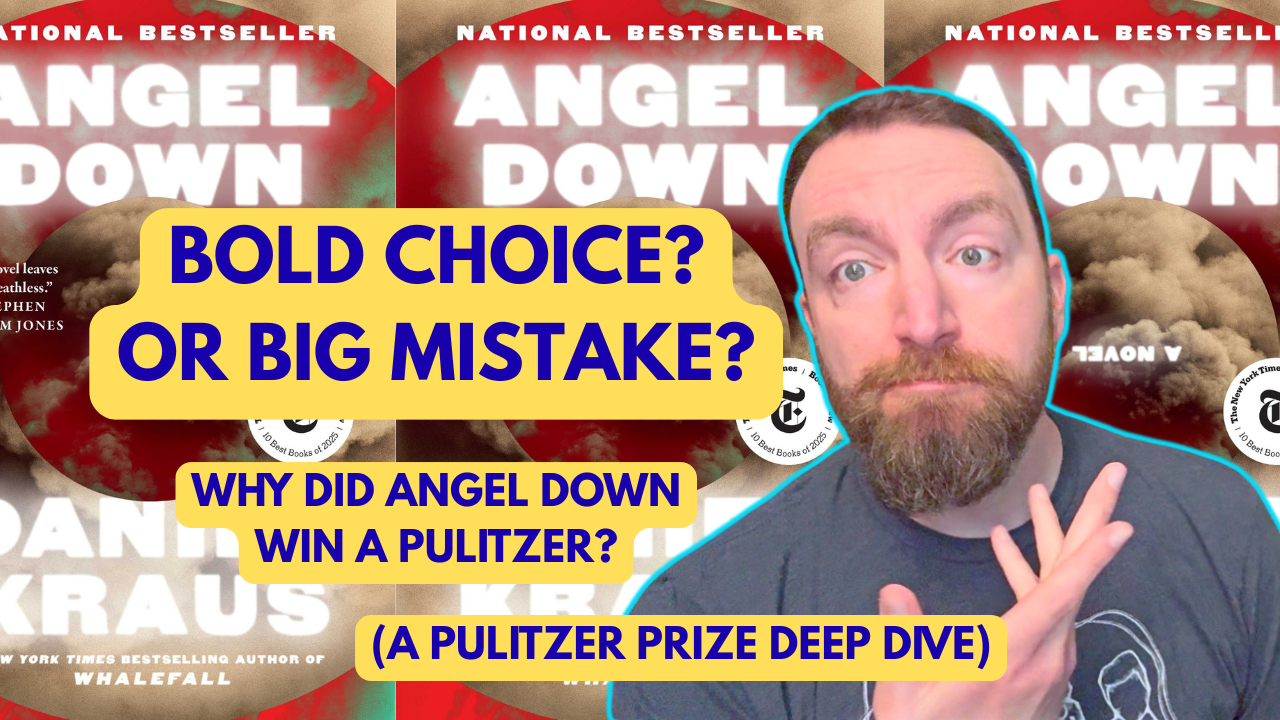
If you saw my reaction to the announcement of the Pulitzer Prize for Fiction this year, you know that I was absolutely shocked. I mean, shocked. That’s because, of the three finalists, I thought it was clear which book would win. Like, abundantly clear. I was wrong. Think of it more as a “Pulitzer Surprise” this year.
Angel Down by Daniel Kraus is a fascinating choice for the Pulitzer because it’s so different. This is a horror novel that now sits on a shelf with To Kill a Mockingbird, Beloved, and other titans of literature. The closest comparitor to Angel Down would have to be Cormac McCarthy’s The Road, but people don’t tend to think of that book as a horror novel, even though it’s an apocalyptic story that features cannibals. Besides, it was written by Cormac McCarthy, one of the most well regarded authors in contemporary American literature.
How did we get here? And does awarding the Pulitzer Prize to Angel Down represent the first shot in a revolution about what classic literature is? Or was it a terrible mistake?
What Is Angel Down About?
Cyril Bagger, a con man who was forced to enlist as a WWI soldier, has spent his time in the trenches trying not to get killed. If other soldiers are rushing to the frontline, he’s finding an excuse to be anywhere else. Mostly, this involves digging graves for the large number of soldiers killed in action. He’s also constantly trying to shake off Lewis Arno, an orphaned 14-year-old boy who lied about his age in order to sign up. Arno is dedicated and hardworking but also emotionally needy (all qualities foreign to our protagonist), and for some reason, he looks up to Bagger. Bagger prefers to be a lone wolf and doesn’t want to get stuck looking out for Arno in what he sees as a lose-lose situation (since the kid is most likely going to die horribly like everyone else around them), so he keeps trying to insult the kid enough that he’ll give up and move on. Unfortunately for him, Arno doesn’t seem to give up easily.
Bagger is the son of a Bishop who lost his faith over time, and who drowned with the Lusitania when he set off to rediscover his belief. As such, Bagger has complicated feelings about religion and faith. He also blames himself for the death of his mother because it was complications from his birth that killed her. And since he can’t help but believe that his father also blamed him, his personality is a complex blend of deep hurt and contempt.
Things come to a head when a piercing shriek that won’t end begins to call from No Man’s Land (the land between German trenches and French/American trenches, where any soldier who dares to venture will be exposed and likely killed). Bagger and Arno are called to the frontline to meet with Major General Lyon Reis, a tyrannical leader with a malformed right arm who is simultaneously desperate to prove himself and angry that he isn’t being appreciated as much as he thinks he should be. Reis has also called Ben Veck, a black flamethrower operator suffering from severe PTSD (or shellshock, as it was known then), Vincent Goodyear, a profiteer unscrupulously robbing battlefields for anything he can trade, and Popkin, an STD-riddled and amoral slob.
Reis is moving on with all their comrades, but he’s assigned what he deems to be the five most useless men to a suicide mission: head into No Man’s Land to “take care” of the shrieker (AKA put them out of their misery, or whatever euphemism you prefer to use for finishing off a critically wounded soldier). So off they go: a con man, an orphan, a shellshocked soldier, a profiteer, and an amoral slob.
But what Bagger and the others find in No Man’s Land isn’t a wounded soldier at all. Instead, they find an angel, apparently wounded by the new technology of this post-industrial war and fallen from the sky. The angel is not communicative and needs to be carried, and as the men try to figure out their next steps, it becomes apparent that they all have very different ideas about what to do with this holy figure. Will she be their savior, will they destroy themselves to claim her, or will she herald their doom?
To avoid spoilers, I won’t go any further.
Is the One Sentence Thing in Angel Down a Dealbreaker?
One of the biggest responses to descriptions of Angel Down since it won the Pulitzer has been a sort of knee-jerk resistance to the book’s single-sentence format. I understand the reluctance, but let me assure you: it sounds a lot more difficult than it is.
First of all, it turns out that Angel Down is compulsively readable. You get drawn in and compelled to continue. Second, it’s only technically a single sentence. There are paragraph breaks on every page, the book is broken into short chapters, and the entire thing is divided into three parts. There are easily digestible sections throughout. If you need a pause, it’s very easy to find a place to stop for the time being.
The single sentence is also thematically addressed within the text of the book only six pages in:
“and Bagger, already weighed down in mud and blood, further heavies in the dreary certainty that the shriek won’t ever end, just like the war won’t ever end, like the carnage won’t ever end, it’s a sentence in a book careening without periods, gasping with too many commas, a sentence that, once begun, can’t ever be stopped, a sentence doomed to loop back on itself to form a terrible black wheel that, sooner or later, will drag each and every person to their grave,”
Daniel Kraus has addressed the single-sentence format himself (including in this Instagram post), saying that Angel Down had a much more traditional style when he initially started it, but when it didn’t feel like it was working, he stopped to consider what he wanted to say with this novel. When he thought about the feeling that society has been stuck in cycles of industrialized warfare since WWI, he came up with the idea of the single sentence looping back on itself to put the reader in the same endless cycle. He also felt that it helped him capture the feeling of being in a war: the assault on your senses leading to disorientation and horror. He also noted that it forced him to abandon the usual tricks of a writer to focus on the rhythm of the text.
In short: don’t worry about the single sentence thing.
Is the Violence in Angel Down a Dealbreaker?
The real question is whether or not you can tolerate the violence, carnage, and gore found on nearly every single page. In a recent weekly wrap-up video, I likened Angel Down to Saving Private Ryan in that it opens with a harrowing scene, occasionally calms down as the characters are on the move, and builds to another harrowing scene.
I can be fairly squeamish these days, but I was able to keep on reading. I think that’s because Kraus is using the violence to prove a point. He’s certainly not glorifying it because he wants you to be put off. The whole point is that we’ve been stuck in violent cycles that have traumatized and overwhelmed us for over a century now. Frankly, if you don’t find it off-putting, you are missing the point.
It’s also true that WWI was violent and upsetting, and it was so violent and upsetting because advances in technology during the Industrial Revolution meant that it was waged on an unprecedented scale and with unprecedented weapons of destruction. In a sense, eliminating a lot of the carnage would be sanitizing what truly was a moment of global horror–at what was now possible, at what the cost of these weapons could be, and whether the human race could survive wars like this.
It reminds me of another Pulitzer winner: Beloved. In addressing the toll of slavery, Beloved is an intentionally unpleasant and thoroughly brilliant novel–one that cautions us against whitewashing the past and forgetting what we’re capable of.
You know your own threshold, so I leave it to you. If you don’t think you can deal with that, I understand. The world feels like it’s on fire right now. With wars raging in Ukraine, Israel, and Iran, we’re all dealing with a lot and trying to find ways to cope.
Are There Adaptations or Sequels?
A film adaptation was announced in January of 2026, well before the Pulitzer Prize announcement. Daniel Kraus will write the screenplay himself. Kraus’ novel Whalefall has also been adapted into a movie starring Josh Brolin and Austin Abrams (it will be in theaters in October of this year).
No word on sequels at this time, though. I’m not sure how a sequel would even work, but with Kraus’ wickedly creative mind, I wouldn’t put it past him.
Who Is Daniel Kraus?
Angel Down is Daniel Kraus’ 12th novel (in addition to collaborations with Guillermo Del Toro and Lisi Harrison, plus three middle-grade books and some graphic novels and comics). He also published a nonfiction book about Night of the Living Dead earlier this year. He is predominantly known as a horror and science fiction writer, making his Pulitzer Prize for Fiction a groundbreaking recognition of a genre typically overlooked by major literary prizes.
In fact, in an Instagram post about his recent Pulitzer win, Kraus specifically thanked the horror community he has been a part of his whole life for embracing his work and supporting him to this point. He also describes himself as finding “beauty in horror” (which really tracks, having read Angel Down). He also pledged that while his work will continue to dabble in other genres, there will always be an element of horror.
And in an earlier Instagram post more specifically responding to the Pulitzer surprise, he described his primary emotions as being “shock and confusion.” He also noted that he tries to do things differently in every book that he writes, saying that his brand is that he has no brand, which can make for a difficult road as an author.
There aren’t many biographical details about Daniel Kraus that I can find, but I do know from that Instagram post that he grew up in Iowa, and his official bio states that he currently lives in Chicago. His Wikipedia page also notes that he was born in Midland, MI, on June 7, 1975. But all in all, after consuming a lot of content from his Instagram page and watching many clips of his interviews, Daniel Kraus appears to be a pretty cool, “normal,” and unassuming guy. He would probably be fun to sit down with over coffee and a muffin.
I would say that most people first heard his name when his novel Whalefall, about a grieving teenager fighting for survival after being swallowed by a dying whale, became a bestseller and scored that movie adaptation I mentioned earlier. With the critical success of Angel Down coming soon after (and now this major literary prize), plus a movie that will be in theaters later this year, Kraus could very well find himself at the forefront of the literary scene for years to come… if he plays his cards right.
Is This Novel Any Good?
I’m not exactly proud of what I’m about to say, but I was surprised by how much I enjoyed reading Angel Down. I realize “enjoy” isn’t a great word given the squeamish subject matter, but hopefully you get what I mean.
This is a book that really says something. One that has a point of view that speaks to our past, our present, and (unfortunately) our future. One that has an incredible level of technical difficulty, pulled off so well that you don’t see the labor Daniel Kraus must have put into writing this novel. One that has a unique style and voice (and how often do you really get to say that in this day and age, when it feels like everything has been done before?). Daniel Kraus is a skillful writer, which I think is why he was able to overcome the stigma that usually holds back genre writers and books.
Having said that, Angel Down is also a messy book. I’m not convinced that it pulls off everything it’s trying to do. For example, I’m left pondering the point of the whole situation with the angel–why it begins and how it ends, etc. But I don’t actually mind all that much because Kraus says some very interesting things about faith and the place of religion in society. He also has a lot to say about religion as a torture device as often as it can be a source of comfort. I like how he uses the angel to capture the corrupting elements of humankind, and how there is no bottom to how low we can go. And I like how he cleverly subverts your expectations about the quality of the angel’s character while using classic depictions of angels that society has chosen to overlook.
I also like the complexity of Cyril Bagger, a man determined to be a bad person in what he (rightly) considers a cruel and unforgiving world, but who has a conscience that constantly thwarts that desire. I like how this echoes something I have decided to believe as I get older: that although humans have the capacity to be terrible, we also have the capacity to be wonderful. That we can choose to be embittered and cruel or we can choose to be hopeful and kind. That even though it often feels like bad people get ahead or cruelty wins all too often, that just makes it more important to choose kindness. Like Cyril, I don’t always succeed, but I think the effort is worthwhile.
So while I don’t think Angel Down will be among my personal best books of the year, I can celebrate this win. First, for Daniel Kraus’ awesome skill as a storyteller. Second, for what the book says about the world and how we live in it. And third, for what it means for genre storytellers everywhere–that their work matters just as much as literary fiction. I’m going to be very disappointed if this win doesn’t turn out to be a paradigm-shifting event in what the literary world thinks of as great literature. Kindred by Octavia Butler is one of the great American novels, but it hasn’t gotten its due until recently because it gets shelved in science fiction. We shouldn’t put literature into silos and only trot one of them out when we’re ready to hand out blue ribbons.
Having said that, I’m not sure I understand what Kraus is getting at with the angel and their intentions. Why are they here? What are they doing? What does it all mean? I haven’t a clue. There’s a whole portion of the final act that doesn’t make much sense to me. That makes it hard to give Angel Down a full-throated endorsement. I like what it stands for and the book’s meaning more than I like the book itself, if that makes sense.
Why Did This Win a Pulitzer Prize?
That is a good question. Maybe we’ll have better answers when we have the benefit of hindsight many years from now, but as someone reacting in the moment, it feels like a genuine surprise. A surprise I can’t quite fathom, if I’m being honest.
I do suspect that this year’s jury wanted to think outside the box a bit. All three of the finalists they selected are experimental in some way (or at least they take some pretty big swings): Angel Down with its complex structure designed to make the reader feel just as discombobulated as the characters; Stag Dance is a groundbreaking selection for making Torrey Peters the first trans person to be a finalist for this prize, and for a book that also pushes the boundaries of gender, identity, and the transition process; and Katie Kitamura’s Audition, which is less of a conventional novel than it is a thought exercise.
The jury was lucky, in a way, because 2025 was a murky year for Pulitzer contenders. Last year, we had a runaway favorite in James (even though it still almost lost). I would say Katie Kitamura’s Audition and Susan Choi’s Flashlight were the closest things we had to frontrunners, but it never felt like either of them could lock it down. Ultimately, only one of them became a finalist (Audition), and even then it couldn’t seal the deal. If 2025 had had a James, things might have ended up very differently.
I almost wonder if the jury was attempting to stack the deck for Audition to easily slide to a victory by putting it alongside a book that flirts with genre in a way that typically turns off the Pulitzer Board (Angel Down) and a book that consists of four stories (Stag Dance). Pulitzer juries frequently put a story collection in the mix, and the Board hasn’t taken the bait in fifteen years. But hearing jury chair Rebecca Makkai’s enthusiasm for all three finalists after the announcement, I do believe that they put forward three books they genuinely loved.
It’s just that, given these three finalists, Audition would be the likeliest winner nine times out of ten. Right now, we don’t know what made the Board choose Angel Down when they didn’t respond to, say, Same Bed, Different Dreams for the 2024 prize. Is it because Same Bed, Different Dreams is speculative fiction and Angel Down is not? Regardless, 12 of the Board members from 2024 were still on the Board in 2025 (a majority). Perhaps the small difference on the Board was enough to move in the direction of a genre-ish title?
Or maybe Angel Down is something of a unicorn. It doesn’t really adhere to a specific genre, after all. It’s horror, but it’s also a bit sci-fi/fantasy, and it’s definitely literary. And book prizes love a story about one of the World Wars.
I think this is the first time in the Pulitzer deep dives I’ve done that I don’t really have a theory (or a clue) as to how a particular book outpaced its competitors. I think in this case it must simply come down to a matter of taste–which is, ideally, how it should go anyway.
Or maybe it comes down to something I said earlier: “With wars raging in Ukraine, Israel, and Iran, we’re all dealing with a lot and trying to find ways to cope.” Maybe a book about the cycles of industrialized destructiveness we’ve been stuck in for over a century is exactly what the jury and Board wanted to put forward. Maybe in a time when being kind and empathetic is all too often dismissed as weakness, Angel Down lands particularly hard.
It seems naive to hope that we’ll learn from Angel Down, since multiple generations have failed, but this book also speaks to hope and the importance of trying. And I like that.
Is Angel Down the Great American Novel?
It’s always difficult to answer this question about recent Pulitzer Prize winners because we can only guess at what the book’s legacy will be. Will people still be reading Angel Down in 50 years? 100? I genuinely don’t know. I confess I’m inclined to be doubtful, but I can see how I could be wrong.
Still, I associate the Pulitzer Prize with the quest for the mythic Great American Novel, and since the jury and Board made their guess, the least I can do is make mine. My take has always been that it’s impossible to instill every American experience in a single volume, so the best we can do is create a canon of Great American Literature. And would I offer Angel Down a space in that canon? Probably not. But that doesn’t mean it isn’t a good or worthwhile read.
What Was Angel Down‘s Competition for the Pulitzer?
The direct competition, of course, is the other finalists: Katie Kitamura’s Audition and Torrey Peters’ Stag Dance. As fate would have it, I’ve already discussed those, so let’s look outside the box.
There were a host of other competitors that would have been a bit of a reach for the Pulitzer’s mandate to preferentially focus on books that deal with American life: Susan Choi’s Booker Prize finalist Flashlight, Megha Majumdar’s National Book Award finalist A Guardian and a Thief, Jonas Hassen Khemiri’s PEN/Faulkner Award for Fiction finalist The Sisters, and Rabih Alameddine’s National Book Award winner The True True Story of Raja the Gullible (and His Mother).
Others were genre (or genre-ish) titles that perhaps didn’t overcome the stigma as well as the winner did: Dream Hotel by previous finalist Laila Lalami, The Slip by Kirkus Prize winner Lucas Schaefer, and Tilt by Emma Pattee.
Then we have big book club picks that sold well but didn’t become finalists: Ocean Vuong’s Oprah-approved The Emperor of Gladness, Patrick Ryan’s Read With Jenna pick Buckeye, and two more books that were blessed by Oprah: Eric Puchner’s Dream State and Bruce Holsinger’s Culpability.
And then there were the literary fiction titles that didn’t make the cut: Lily King’s Heart the Lover, Angela Flournoy’s The Wilderness, Addie E. Citchens’ Dominion, Karen Russell’s The Antidote, Virginia Evans’ The Correspondent, and Thomas Pynchon’s Shadow Ticket.
You could make a case for many of these titles and why they should have become finalists, which is in part why 2025 was such a murky year for choosing a winner.
Should Angel Down Have Won the Pulitzer Prize for Fiction?
First, I want to say I love that the Board went out of the box on this one. Choosing Angel Down stretches the limit of what a Pulitzer Prize book can be, and I hope the Board continues to build off of that. If this ends up being a one-off, it would feel mighty disappointing. And I do think there’s a solid case to make for Angel Down and Daniel Kraus. I’m certainly not as bitter about this win as I was about Night Watch or The Netanyahus. Not by a long shot.
But if I were on the jury, would I put Angel Down forward to the Pulitzer Board? Probably not. If I were on the Board, would I have selected Angel Down? Well, I might if I had to choose from the three finalists we got. I wasn’t a fan of Audition, and I admit I don’t have much interest in Stag Dance, even if it sounds like a book I would be all over.
The point I’m making is this: even though I enjoyed Angel Down and I’m glad the Pulitzer forced me to get out of my comfort zone to read it, it wouldn’t have been my choice.
Instead, my finalists would have been the criminally overlooked The Imagined Life by Andrew Porter, the sensational debut Dominion by Addie E. Citchens, and the quiet joy of The Correspondent by Virginia Evans. Of those, I would debate between The Imagined Life and Dominion for a long time. And although The Imagined Life is my personal favorite, I would vote for Dominion.
Other Pulitzer Prize Deep Dives
His Family (1918) • Now in November (1935) • Gone With the Wind (1937) • The Grapes of Wrath (1940) • To Kill a Mockingbird (1961) • The Color Purple (1983) • Lonesome Dove (1986) • Beloved (1988) • Interpreter of Maladies (2000) • March (2006) • Tinkers (2010) • Less (2018) • The Netanyahus (2022) • TIE: Trust and Demon Copperhead (2023) • Night Watch (2024) • James (2025) • Angel Down (2026)
Deep Dives On Pulitzer Years With No Winner